
Sidney A. Benson (March 28, 1922 - June 29, 1944)
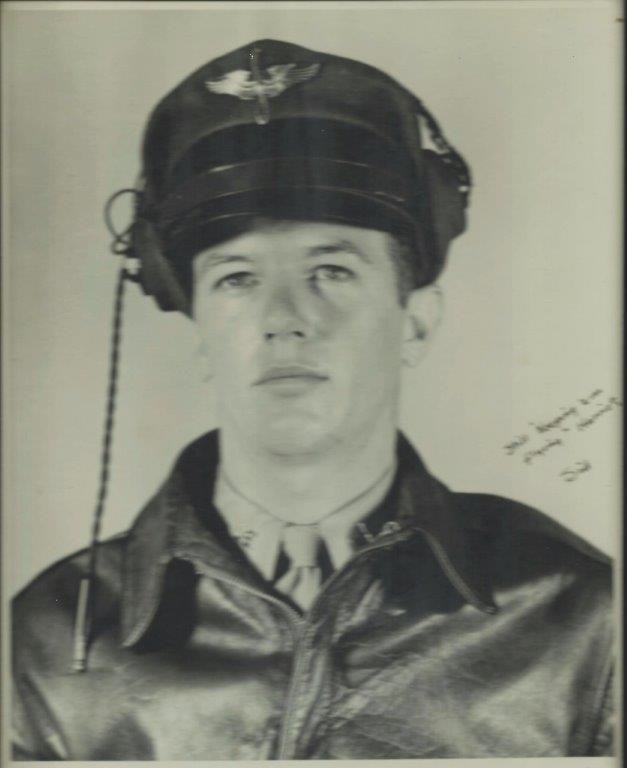
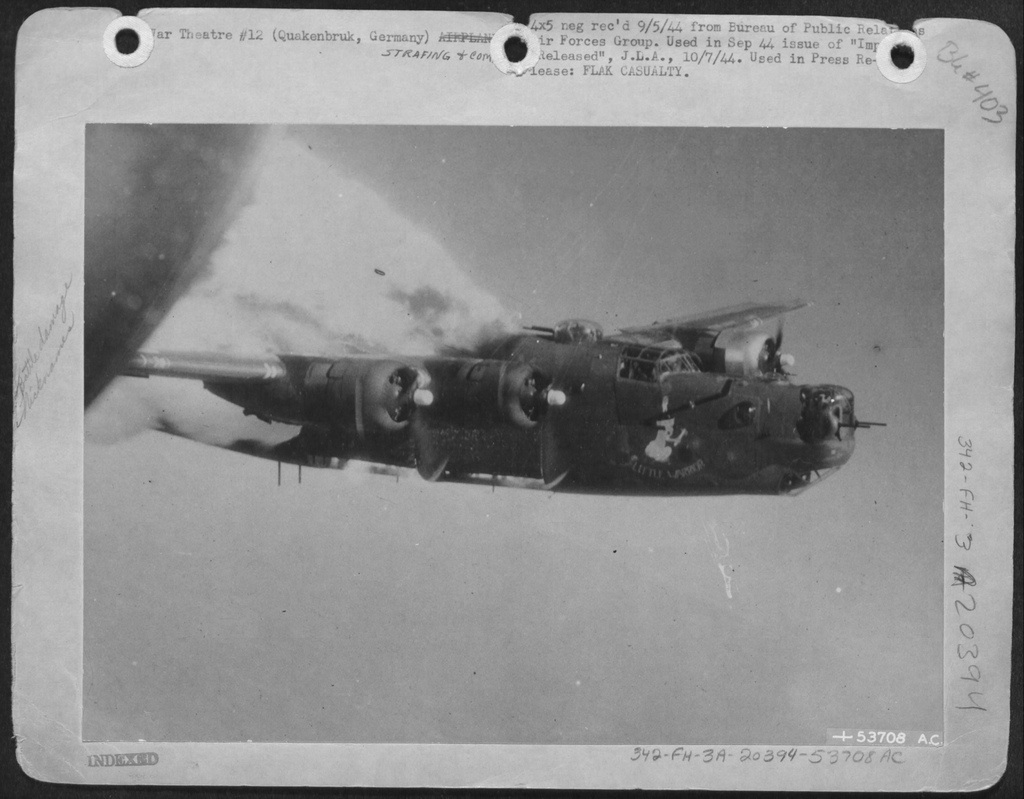
On June 29, 1944, a squadron of B-24 bombers of the U.S. Air Force flew an attack on the Volkswagen factory. In the process, the "Little Warrior" was shot down by German air defenses - 2nd Lieutenant Sidney A. Benson alone managed to eject from the burning plane. He was able to save himself with his parachute and landed unharmed on the ground of the German Reich on the western edge of the present-day Wolfsburg district of Windberg. Less than twelve hours later, at about 10 p.m. the same day, he was dead. He was the victim of a cruel form of vigilante justice.
His ordeal began immediately after the landing, when he was captured and handed over on the spot to an HJ leader. The latter shot him several times in the back during an alleged escape attempt. Benson dragged himself to the city hospital, where he was met by several air-raid wardens.
A mob of about 50 to 60 people kicked and beat the defenseless airman with iron bars, among other things, and he was left lying in a ditch, covered in blood and with his skull crushed. A nurse would later testify, when the case was tried in the postwar Military War Court in Dachau, that his face was "just a lump of blood." The investigating prosecutor recognized, as he noted in a memorandum during the trial, in fact "a clear case of murder by mob violence." Even in the hospital, the unconscious soldier was initially denied any help; indeed, the mistreatment continued at the medical level: a nurse deliberately administered a dose of morphine that was far too high.
The Wolfsburg case is one of a whole series of comparable "Fliegerlynchjustiz" murders, and far more than 300 cases have been handed down. They attest to an increasing radicalization of German society at the time. The collective lack of a sense of injustice, which made such acts of self-empowerment possible in the first place, was a consequence of successful Nazi propaganda, which made it clear that in cases of "lynch law," police and criminal prosecution would be discouraged. By depriving the bomber pilots of their status as soldiers, it acted contrary to current international law.
Those responsible for the death of Sidney A. Benson, with few exceptions, were able to continue their lives unmolested. Even the two who were tried and convicted at Dachau in the postwar period did not have to serve their sentences and were released early from prison.
Text: Dr. Alexander Kraus
The Airmen's Murder in the "City of the KdF Car" - The Sequence of Events on June 29, 1944
During the bombing raid on the Volkswagen plant on June 29, 1944, one of the 41 aircraft was hit by an anti-aircraft gun while flying at an altitude of 20,000 feet. The bomber, which caught fire as a result, began to yaw and was in danger of colliding with the aircraft next to it. The pilot managed to avoid a collision before the aircraft became uncontrollable and broke apart at an altitude of 10,000 feet [2]. Nine of the ten crew members were killed when their aircraft crashed. Only the co-pilot, Sidney A. Benson, was able to save himself by parachuting and landed unharmed in a field near a forest on the western edge of what is now the Windberg district of Wolfsburg.
The events took place, transferred to today's city map, at the following locations: between the western edge of the Windberg settlement, about 200 m south of the road, according to the version of one of those involved in a field where the allotment "Am Schäferbusch" is located today, as well as on Reislinger Straße up to Kiebitzweg (west of Reislinger Markt, opposite Rosenweg and the health office), where the city hospital was located at that time.
Sidney A. Benson unbuckled his belt, to which the parachute was attached, and removed his flight suit. At the same time, a German anti-aircraft soldier approached him with a firearm. Sidney A. Benson walked toward the soldier with his hands up and surrendered to him voluntarily. He was then searched by two policemen.
The events that follow can be divided into three circles of action that are intertwined. They are indicated by the red line:
1. the way to the hospital on Reislinger Street,
2. the abuse in front of the entrance to the hospital grounds (marked M), and
3. the treatment of Benson in the hospital.
The capture
HJ leader Helmut Lippmann, in whose air-raid protection district the landing site was located, took charge of the American pilot to bring him to the police [3]. On Reislinger Street, heading toward the center of the “City of the KdF Car,” Benson attempted to escape, according to Lippmann, just as four-engine bombers flew overhead from the east.
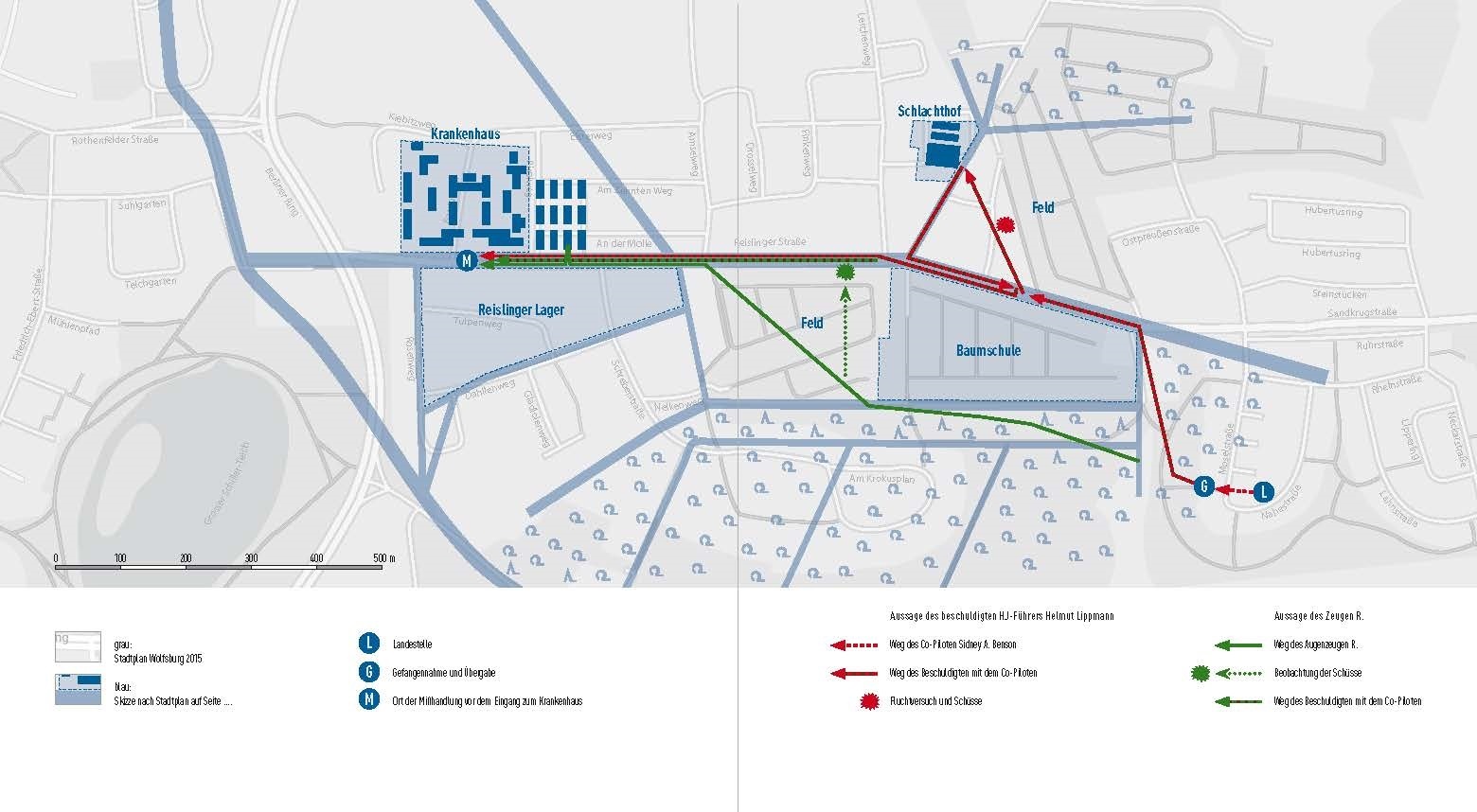
Lippmann, who was riding his bicycle and had aimed his pistol at the soldier running a few meters ahead of him, shouted for him to stop, but the American soldier did not comply. Lippmann then fired. The soldier, however, kept running. Even four more shots did not stop him, although three of them had hit him. Lippmann caught up with the soldier near the slaughterhouse, walked back with him to his bicycle, and then continued along Reislinger Straße to the entrance of the hospital grounds.
According to Lippmann’s testimony, Benson was able to continue running without any apparent impairment even after being hit by the shots. The shots did not elicit any physical reactions. After catching up to the pilot, Lippmann saw three bullet holes from behind on the outer left side of his clothing, spaced about ten to twelve centimeters apart, but no blood. Thus, according to Lippmann, he could not determine whether he had hit the pilot’s body. It was only because Benson no longer held his hands as high as before on the way to the hospital that he assumed the pilot was injured [4].
This account of the events by the HJ leader is contradicted by the testimony of an eyewitness, R., who claimed to have heard and seen the shots from a distance of approximately 300 m. He stated that he had not observed any attempt to flee, meaning that Lippmann had shot at the pilot without cause.
These two conflicting accounts played a decisive role in all proceedings against the defendant Lippmann: The defendant’s defense team stuck to his version involving the escape attempt, while the prosecution relied on the eyewitness’s account, according to which Lippmann had fired without cause.
According to his account, when Lippmann arrived with the pilot in front of the hospital, he asked some air raid wardens standing there to keep an eye on Benson, as he wanted to call the police from inside the hospital to ask if he could leave the pilot there. After a few minutes, he came out of the hospital having achieved nothing, saw that the plane had been tampered with, immediately turned around, and fetched Head Nurse E., who then took care of the prisoner [5]. Lippmann drove to the police station to report the events.
According to his statement, the eyewitness R. noticed, after spending a few minutes in his apartment, a crowd of about fifty to sixty people—including air raid wardens—gathered in front of the entrance to the hospital grounds, and he went over to them. The pilot lay seriously injured in the roadside ditch; the abuse had ceased. In response to his remark that this was Bolshevism, Lippmann replied that it was an order from Goebbels and that they were supposed to do this. Air raid wardens then carried the pilot into the hospital, and Lippmann left the scene of the incident [6].
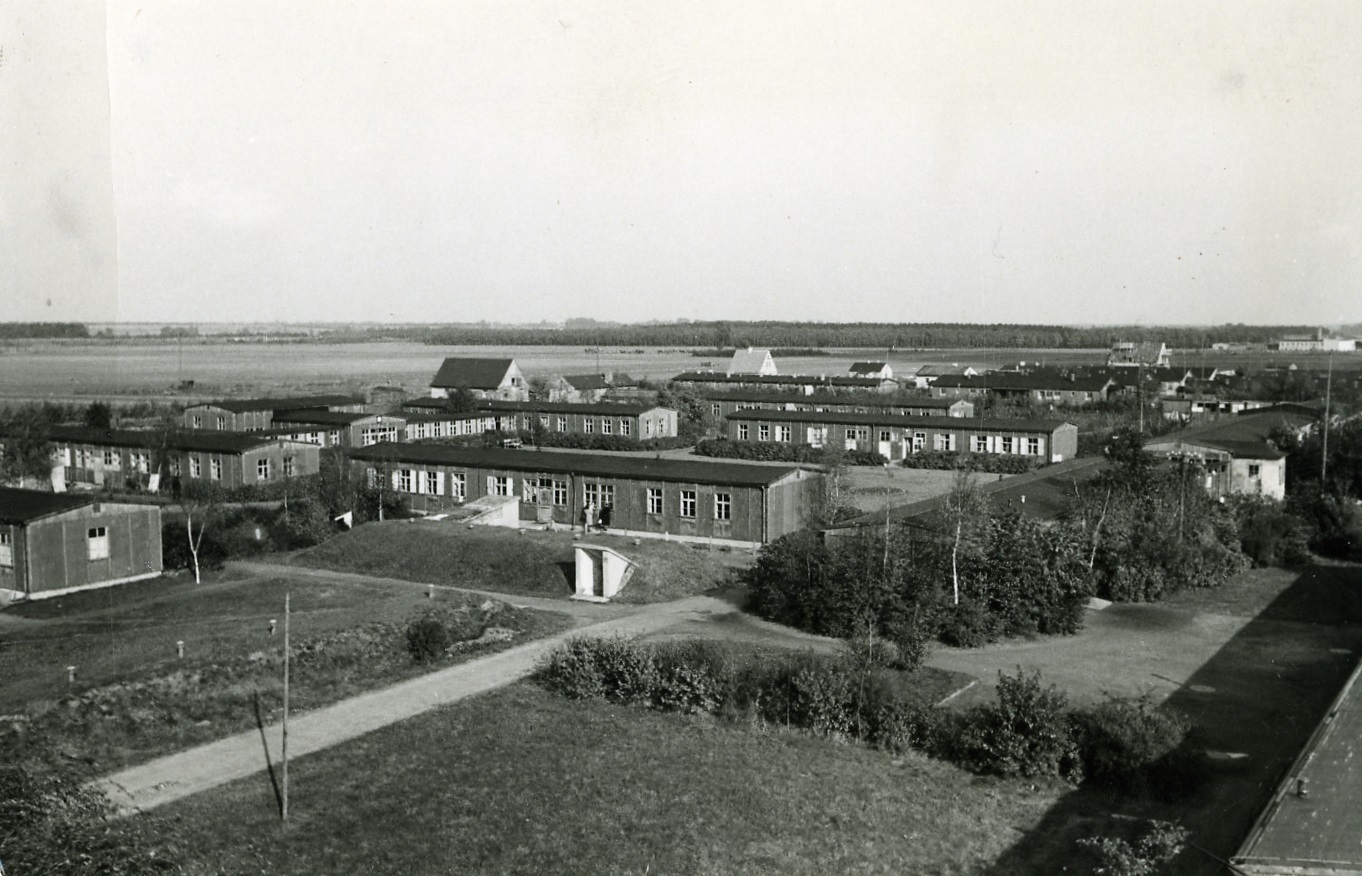
The situation in front of the barracks of the city hospital
In front of the entrance to the hospital grounds, the air raid wardens in particular—but also a woman—must have beaten the defenseless pilot on the head and all over his body, not only with their hands but also with steel helmets and iron bars [7]. An air raid warden reported, “that people from the crowd were beating the pilot, so that he fell into the ditch covered in blood.” [8]
They must also have kicked him, with one air raid warden distinguishing himself “by kicking the pilot in the face and stomach with the heel of his boot.” [9] There are reports of people in the crowd shouting that such people should be beaten to death [10]. Lippmann himself told the head nurse that people might kill the prisoner [11], who was lying in the ditch, covered in blood and unconscious [12], when the head nurse took him into his care. A nurse reported that, based on marks on his neck, someone must have tried to strangle the pilot [13]. That afternoon at the Volkswagen plant, an air raid warden boasted that he had beaten or killed the pilot [14].
When the head nurse arrived at the scene of the assault—in front of the entrance to the hospital grounds—the pilot was handed over to the hospital staff. The head nurse was now in charge of the situation. However, the abuse did not end there.
According to his own account, the head nurse ordered the air raid wardens to bring the pilot into the hospital [15]. They carried the seriously injured man “by his hands and legs, so that his buttocks dragged along the ground.” [16] Not only did his buttocks dangle, but so did his head [17]. A witness recounts a statement by an air raid warden according to which the men “even grabbed the pilot by the feet and dragged him like a dog [18].” According to his own statement, the head nurse had to “have a stretcher brought in because of the brutality of these four men, on which (the pilot) was then transported to the hospital. [19] ” However, a nurse accused the head nurse of having participated in the abuse [20]. An air raid warden admitted (and this was the only confession made by the air raid wardens) to “having brutally placed the American airman on the stretcher.” [21]“ He also confessed to having attacked the injured airman with an iron bar during transport to the hospital, saying, ‘I’m going to beat that dog to death.’ [22]“ Only the intervention of the nursing staff prevented this from happening [23]. The destination of the transport was not a hospital ward, but the morgue. A nurse passing by protested, “You can’t just take a living person to the morgue.” As a result, they took the pilot to a shed [24].
A nurse and an air raid warden claimed that two nurses had refused to admit the American pilot to the hospital, saying, “We don’t treat enemy pilots.” [25]. Sara Frenkel, who worked as a nurse at the city hospital, also wrote sixty years later: “A German nurse refused to treat his severe wounds—she wouldn’t treat an American, after all [26].” The two nurses accused of this denied the allegations [27].
The medical care
Dr. Karl Riffelmacher was called and examined the American pilot, concluding that he had severe head injuries as well as small lacerations and extensive bruising all over his body, and that nothing more could be done for him [28]. He gave instructions to tend to the pilot, bandage his wounds, and take him to the hospital [29]. He also ordered that the very agitated patient be given “the usual dose of morphine (1 cc of a 2% solution)” [30]. The head nurse administered this injection to the pilot [31] —according to nurses, at ten times the normal dose and with the intent to kill him [32]. The transfer to Dr. Riffelmacher’s surgical ward did not take place. The unconscious pilot was taken to a nearby garage [33]. The head nurse explained this by saying that “another room had to be cleared first, and we assumed anyway that the pilot would die soon. [34] ”
Between 2:00 and 4:00 p.m., Dr. Riffelmacher and the chief physician, Dr. Körbel, arrived to see the American pilot [35]. Dr. Körbel, who had just returned from Lüneburg, “raised a huge fuss about a seriously injured patient being taken to a garage [36].” He “arranged for the patient to be transferred to the ward [37].” During the interrogations, Dr. Riffelmacher expressed his surprise that his instructions from that morning had not been followed [38]. Apart from the injection, no further treatment—neither medical nor nursing—took place until the second rounds, meaning for at least two hours [39].
The unconscious pilot was prepared for admission by the nursing staff in the garage and then transferred to Dr. Körbel’s infectious diseases ward [40]. There, moist compresses were placed on his face to reduce the swelling [41].
The Polish nurses Lea and Charlotte Bass (Sara Frenkel and her sister) reported that they wanted to care for the injured man but were prevented from doing so and punished for it [42].
Sidney A. Benson died alone in a room around 11:00 p.m. There is no record that he had regained consciousness. The doctor’s death certificate listed the cause of death as: “Consequences of severe head injury, suspected skull base fracture” [43].” The municipality’s casualty report to the Wehrmacht command post listed the cause of death as: “crashed in an airplane (seriously wounded) [44].”
Sidney A. Benson was horribly mauled. A nurse described him as follows: “The pilot’s face was nothing but a mass of blood, and his knees were completely shattered [45].” Another nurse testified “that the seriously injured man’s face had been beaten beyond recognition and his neck was severely swollen from strangulation [46].” Because his neck was so swollen, his face and neck had merged into a single mass. There was a laceration on his upper lip. His entire face was swollen, and his eyes were shut tight. Another laceration was located above his right eye. The pilot was bleeding from his ears and breathing heavily [47]. Another nurse confirmed that his neck was swollen and blue due to strangulation: “You could see a dent on his head; he was bleeding from his nose, mouth, and ears. His eyes were swollen, and his lip was badly split open. His face was bluish, and his neck was severely swollen. He had graze wounds on his side [48].” In a subsequent interview, she stated for the record that his skull was shattered and his forehead was completely soft. In addition, his breathing was irregular [49]. She described the injured Sidney A. Benson as a “shot-up and completely trampled pilot” as well as “half-dead” [50].
"Self-empowerment" of citizens
The events surrounding the murder of the pilot on June 29, 1944, outlined here in brief, can only be an approximation of the truth due to the contradictory and varying statements—naturally influenced by self-interest—made by the accused and witnesses. This case clearly illustrates the aggressive atmosphere that prevailed during the final year of the war, which targeted surviving Allied airmen and cost the lives of well over 300 of them.
In the “City of the KdF Car,” in addition to Hitler Youth leader Lippmann, air raid wardens, and hospital staff, others were presumably also involved in the attacks on the American airman. Even if one did not actively participate, one at least tolerated it. As Klaus-Michael Mallmann puts it, the acts of violence committed against the Allied airmen were “crimes that must be viewed largely outside the context of command and obedience, in which it is hardly possible to distinguish between decision-makers and accomplices.” Even in the Third Reich, lynchings could not simply be ordered ‘from above.’ It was not the ‘you must’ that prevailed here, but the ‘you may.’ [51]“
This represented a new quality of violence in the “Third Reich”—one that was not state-mandated or carried out within state-prescribed structures, but was voluntarily exercised by citizens in the spirit of “self-empowerment.”
There was no fear of punishment for this serious crime, because the Nazi leadership incited the people to murder Allied pilots. On May 28, 1944, the *Völkischer Beobachter* published an editorial by Joseph Goebbels—agreed upon with Hitler—entitled “A Word on Enemy Air Terror.” In it, it is made clear that lynchings of enemy pilots are endorsed by state authorities: “It seems to us hardly possible or tolerable to deploy the German police and the Wehrmacht against the German people when they treat child murderers as they deserve [52].” Goebbels also announced this on the radio [53]. In his diary entry of May 30, 1944, he wrote unequivocally: “The great hunt for pilots will soon begin in Germany [54].”
Nazi propaganda against Allied pilots also found its way into local media. Goebbels’ article was printed on the front page of the “Aller-Zeitung” on May 30, 1944—two days after its publication in the *Völkischer Beobachter*. NSDAP district leader Lütge gave a speech at a staff assembly at the Volkswagen plant in June 1944, in which he essentially said that he did not expect any member of the party to hand over one of these “terror pilots” to him alive [55]. Shortly thereafter, in the city of the KdF car, the American pilot Sidney A. Benson was murdered.
-
References
[1] These remarks are based on my 70-page report on the murder of the pilot in the “City of the KdF Car” and its legal investigation, which is housed in the library of the Institute for Contemporary History and City Presentation in Wolfsburg.
[2] See http://www.dvrbs.com/ccwd-WW2/WW2-LittleWarrior-SidneyBenson.htm [zuletzt aufgerufen am 16.11.2014]. See also Brian Lindner, “Unraveling the Mystery of the ‘Little Warrior,’” June 29, 2009, available online at: http://www.wickedlocal.com/article/20090629/News/306299864/?Start=3 [zuletzt aufgerufen am 10.12.2014].
[3] This footnote, as well as the following ones, refers to documents from the National Archives in Washington, which are held as microfilm copies at the IZS. The page numbers correspond to the numbering of the individual items in the trial file. See the interrogation of Helmut Lippmann, October 10, 1946, pp. 3 and 7; main trial (HV) of April 4 and April 8, 1947, statements by the prosecutor, pp. 8ff., testimony of witness R., pp. 63ff., testimony of Lippmann, pp. 99 and 102ff.; see also: Lindner, Unraveling (as in note *).
[4] See testimony of Lippmann, October 10, 1946, pp. 3 ff. and pp. 7 ff.; Main Hearing, April 8, 1947, pp. 98 ff. and pp. 107 ff.
[5] See Lippmann’s testimony, Oct. 10, 1946, pp. 3 ff., pp. 7 ff.; HV, Apr. 8, 1947, pp. 99 ff., pp. 109 ff.
[6] See testimony of witness R., HV, April 8, 1947, pp. 63 ff., 69 ff., 84, 87 ff., 90 ff.
[7] See testimony of witness Kl., September 23, 1945; testimony of Ku., October 31, 1946; complaint filed on October 9, 1945, against four civil defense officers, including a “statement of position and indictment.”
[8] Interrogation of air raid warden A., September 24, 1945.
[9] Complaint dated October 9, 1945, against four air raid wardens, including a “statement of defense and indictment.”
[10] See testimony of E., Fallersleben District Court, November 3, 1952, p. 7.
[11] See testimony of witness W., March 31, 1947, p. 4.
[12] See complaint dated October 9, 1945, against four air raid wardens, including “Statement and Indictment”; testimony of air raid warden A., September 24, 1845.
[13] See the affidavit of witness W., July 5, 1946.
[14] See testimony of Ku., October 10, 1945.
[15] See the testimony of E., September 19, 1945.
[16] Statement by witness W., September 19, 1945; see also the statement by witness Sch., September 19, 1945.
[17] See the testimony of witness W., March 31, 1947, p. 2.
[18] Witness Marie Stach, July 26, 1945.
[19] Statement by E., September 19, 1945.
[20] See witness Hanna Kannareck, September 14, 1945.
[21] Statement by Ku., September 20, 1945 (interrogation transcript from September 19 and 20, 1945).
[22] Statement by Ku., September 20, 1945.
[23] See statement by E., September 20, 1945; witness W., September 19, 1945; witness Sch., September 19, 1945.
[24] Witness W., September 19, 1945; see also Witness W., July 5, 1946; Gertrud Schuster, March 31, 1947, p. 2; statement by witness Sch., March 31, 1947, p. 2.
[25] See witness Hanna Kannareck, September 14, 1945; statement by Ku., September 19, 1945; statement by E., September 19, 1945.
[26] Sara Frenkel, “The Fear Was Always There,” p. 67, in: Manfred Grieger/Ulrike Gutzmann/Dirk Schlinkert (eds.), Surviving in Fear. Four Jews Recount Their Time at the Volkswagen Plant from 1943 to 1945, Wolfsburg 2005, pp. 54–71, here p. 67.
[27] See Witness W., September 19, 1945; Witness Sch., September 19, 1945.
[28] See Witness W., September 19, 1945; Dr. Riffelmacher, September 26, 1945, and HV, April 4 and 8, 1947, pp. 39ff.
[29] See Dr. Riffelmacher, HV, April 4 and 8, 1947, p. 49; Witness W., March 31, 1947, p. 7.
[30] See Dr. Riffelmacher, September 26, 1945; Dr. Riffelmacher, HV, April 4 and 8, 1947, p. 49.
[31] See statement by E., September 19, 1945: “I admit to having given the injured man an injection of morphine on Dr. Riffelmacher’s orders.” E. did not specify the dosage.
[32] See Charlotte Bass, September 14, 1945; Lea Bass, September 14, 1945; and Hanna Kannareck, September 14, 1945.
[33] See statement by E., September 19, 1945; witness W., September 19, 1945.
[34] Statement by E., September 19, 1945.
[35] See Dr. Riffelmacher, September 26, 1945; Dr. Riffelmacher, HV, April 4 and 8, 1947, p. 41.
[36] Witness W, September 19, 1945, and March 31, 1947, p. 7; see also Hanna Kannareck, September 14, 1945.
[37] Witness W, September 19, 1945, and March 31, 1947, p. 7.
[38] See Dr. Riffelmacher, HV, p. 41 ff.; Dr. Riffelmacher, September 26, 1945.
[39] Statement by Witness W., March 31, 1947, p. 7ff.
[40] See Witness Sch., March 31, 1947, p. 5 ff.; testimony of Ku., July 26, 1945.
[41] See witness W., July 5, 1946, and March 31, 1947, p. 8; Dr. Riffelmacher, HV, April 4 and 8, 1947, p. 49.
[42] See Lea and Charlotte Bass, September 14, 1945.
[43] See Dr. Riffelmacher, June 5, 1946 (City Hospital, Surgical Department); Dr. Riffelmacher, HV, April 4 and 8, 1947, p. 50; see also the death certificate (StAWOB HA 4625). The document lists the date and time of the postmortem examination as “June 30, 1944, 10 a.m.”; see also the obituary notice sent by the police administration to the city’s registry office regarding the KdF car; some of the entries are identical to those on the death certificate.
[44] Missing person report from the municipality to the Wehrmacht Command Headquarters dated July 8, 1944 (StAWOB HA 2793).
[45] Hanna Kannareck, September 14, 1945.
[46] Witness Sch., September 19, 1945.
[47] See Witness Sch., March 31, 1947, p. 2ff.
[48] Witness W., July 5, 1946.
[49] See Witness W., March 31, 1947, p. 2 and p. 8: “...the top of his head was smashed to bits. The front was all soft.”
[50] See Witness W., September 19, 1945.
[51] Klaus-Michael Mallmann, “People’s Justice Against Anglo-American Murderers.” The Massacres of Western Allied Airmen and Paratroopers in 1944–45, in: Alfred Gottwaldt/Norbert Kampe/Peter Klein (eds.), Nazi Tyranny: Contributions to Historical Research and Legal Analysis, Berlin 2005, pp. 202–213, here pp. 212–213.
[52] Joseph Goebbels, “A Word on Enemy Air Terror,” in: *Völkischer Beobachter*, May 28–29, 1944, p. 1, and in: *Aller-Zeitung*, May 30, 1944, p. 1.
[53] See http://www.gelsenzentrum.de/fliegerlynchmord_gelsenkirchen.htm [zuletzt aufgerufen am 10.12.2014]; Goebbels’ speech of June 4, 1944, in Nuremberg, in: Helmut Heiber (ed.), Goebbels Speeches 1932–1945, Bindlach 1991, pp. 336ff. [s. auch 6. Absatz (S. 324) und Erläuterung des Herausgebers am Ende der Rede (S. 341)].
[54] The Diaries of Joseph Goebbels, Part II: Dictations 1941–1945, Volume 12: April 12–June 1944, edited by Hartmut Mehringer, Munich 1995, p. 370 (diary entry from May 30, 1944).
[55] See testimony of witness Br., HV, pp. 31ff.
-
Contact
City of Wolfsburg
Institute for Contemporary History and City Presentation
Goethe School
Goethestrasse 10a Entrance C
38440 WolfsburgTelephone: 05361 27-5730
Fax: 05361 27-5757E-mail: izs-stadtarchiv@stadt.wolfsburg.de