
The Wolfsburg professional fire department provides firefighting, rescue services and disaster control
Civil Protection

Extreme weather, a chemical spill, a widespread power outage or a fire - there are various emergency situations that can occur unexpectedly. Those who act correctly in these situations can protect themselves and others and reduce damage.
The Federal Office of Civil Protection and Disaster Assistance (BBK) provides helpful tips for this, which we pass on here in condensed form for you.
Want to help?
Take the quiz and find the right volunteer opportunity in civil protection for you.
In the following brochure, you’ll find a quiz and guidance to help you decide which area you could help in, based entirely on your interests and skills. It also lists the contact information for all the major aid organizations.
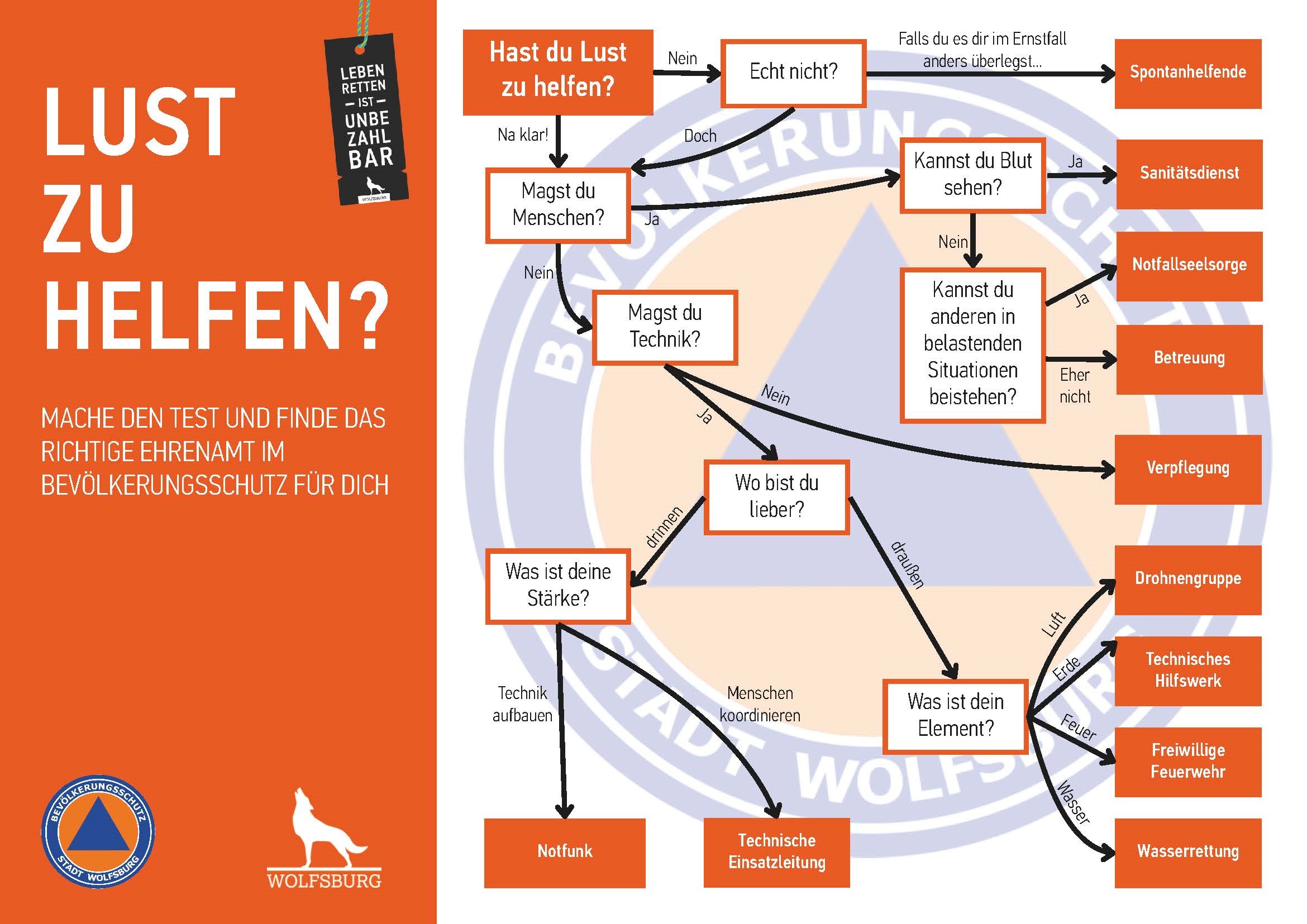
You can obtain this information directly from BBK
Cell Broadcast
From 23.02.2023, the city of Wolfsburg can now also issue warning messages using Cell Broadcast. Following the successful test of the system on Warning Day in December, the municipalities can now also use the system and include it in their warning media mix. This means that various warning media such as warning apps (including NINA), sirens, digital city information boards from Ströer, radio announcements and the Cell Broadcast system are available to the city of Wolfsburg's civil protection department.

Cell Broadcast can basically be used to send alerts to all mobile devices (smartphones and conventional cell phones) located in a specific section of the mobile network, a so-called radio cell. An additional installation of apps is not necessary.
Further information on Cell Broadcast can be found on the BBK website.
Siren tones and announcements
If an emergency occurs, you will be notified via the citywide network of so-called “talking sirens.” First, you’ll hear a traditional wailing siren sound. In addition, these sirens may also broadcast a voice announcement informing you of what has happened or how you should respond.
You can listen to the siren sounds and announcements below.
Siren sounds
The following siren tones will inform you about the sirens in the city area in case of emergency
Fire alarm" siren tone
3 tones of 12 seconds duration each with 12 seconds pauseDisaster and civil defense alarm" siren tone
6 tones of 5 seconds duration each with 5 seconds pause (1 minute wailing tone).All clear" siren tone
1 continuous tone of one minuteAnnouncements
You can hear the following announcements via the speaking sirens in the city area, depending on the emergency situation. The announcements are made in German and English language
Voice announcement "Turn on the radio"
A voice says: First in German "Radio einschalten" and then in English "Tune in radio".
Voice announcement "Close windows and doors"
A voice says: First in German "Fenster und Türen geschlossen halten" and then in English "shut and secure windows and doors".
Voice announcement "Emergency number disabled"
A voice says: First in German "Notrufnummer ausgefallen, Radio anschalten" and then in English "emergency number disabled, tune into radio station".
Voice announcement "Disaster alert"
A voice says: First in German "Katastrophenalarm, einschalten Radio " and then in English "disaster alaram, tune into radio station".
Voice announcement "All clear"
A voice says: First in German "all clear danger over" and then in English "all clear and off danger".
Questions and answers
-
Where can I get reliable information?
If there is a special emergency situation in Wolfsburg, the disaster control team (HVB staff) usually meets. This staff is headed by the chief administrative officer - i.e. the Lord Mayor - of the City of Wolfsburg and consists of the professional fire department, the police, the medical services, the THW, as well as various other aid organizations and, if necessary, even the German Armed Forces. Depending on the situation, other official representatives, for example from the health department, veterinary office or other specialist consultants (gas/water works, energy suppliers, specialist companies) can be called in.
The HVB staff provide comprehensive and timely information via all municipal communication channels. These are
- The municipal website Special events (wolfsburg.de)
- The city's Facebook fan page
 Only these two channels provide you with reliable first-hand information about the situation.
Information from other sources such as Facebook groups should be treated with caution. It may be hearsay and speculation and may not correspond to the facts.
In addition, the HVB staff uses the Modular Warning System of the Federal Government (MoWas). MoWas is used to transmit important information to radio and television as well as the NINA warning app as required.
With the emergency information and news app NINA, you receive important information directly on your cell phone, provided you have installed this free app.
-
How should I act in a defense case?
In the guidebook for emergency preparedness and proper action in emergency situations, the BBK provides recommendations for taking precautions for various emergency situations, including stocking up on food and drinks, creating a first-aid kit or preparing emergency luggage.
As a general rule, all of these precautionary measures are helpful in a disaster situation as well as in a case of tension or defense. In a concrete threat situation, event-related instructions and behavioral recommendations are published by the responsible authorities. This can happen in a variety of ways - on the municipality's website, through a regional radio station, or even through public address trucks. Find out how your municipality informs people in the event of a threat. It is essential to follow the orders of the authorities in the event of a crisis.
In general, we recommend that you prepare for emergency situations. These often come as a surprise. Our guide contains many tips on how you can prepare for different emergency situations. -
Where can I find shelters?
Review
As a result of the peace dividend in the 1990s, after the end of the Cold War, the public shelter concept was not continued.
The functional preservation of shelters was discontinued in 2007 following a decision taken by mutual agreement between the federal and state governments. The reversal process then began.
CurrentlyThe original public shelters are mainly privately owned and owned by local authorities. Most of these facilities have already been reversed.
Under certain conditions, this building fabric can provide basic protection against the use of weapons of war.
Due to the war in Ukraine, the federal government has decided to suspend the further reversal of public shelters for the time being and to review the existing concept.
As a first step, the federal government, together with the federal states, will soon carry out a complete inventory of the remaining shelters. The Federal Agency for Real Estate is responsible for this process.
Irrespective of the question of the current availability and usability of public shelters, the Federal Republic of Germany currently has a very solid building stock throughout the country.
Protection from weapons of war
These are mainly
- Subway stations,
- Underground garages, especially in urban areas,
- basements in solid construction.
This building fabric is completely below ground level. It therefore offers good basic protection against:
- an explosion pressure wave,
- very dangerous flying debris and splinters, as well as
- falling debris.
Stairwells or interior rooms
In an emergency, stairwells or interior rooms that are above ground but have no openings to the outside (e.g. no windows or glass fronts) can still offer significant protection against the effects of weapons.
-
Why should I make provisions?
Disasters are a part of life. Almost every day, we read about disasters and major incidents in the media and see images of destruction and suffering. But it’s not just the major disasters that affect entire regions for long periods of time.
A localized downpour, a severe storm, a subsequent power outage, or a house fire can trigger a very personal disaster for any individual or family—one that must be dealt with. Take the time to think about your personal emergency plan.
Once an emergency has occurred, it’s usually too late to take preventive measures. If there’s a fire, you must react immediately. If you and your family need to be evacuated, you can’t start packing your emergency bag first. If the power is out for days, you should have an emergency supply at home.
Think about your personal emergency preparedness! -
Is emergency stockpiling the same as "hoarding" - and isn't that bad for the community?
In today’s vernacular, “hoarding” refers to stockpiling food or other items that might supposedly become scarce—“hoarding purchases” are therefore impulsive and ill-considered.
If goods do indeed become scarce, it’s also rather unsupportive to hoard products beyond one’s personal needs. An emergency supply, on the other hand, is deliberately built up during times of plenty with only the bare essentials, so that one can easily get by for about ten days.
If every single person builds up a stockpile during times of plenty, shortages in an emergency can be collectively overcome. An emergency stockpile is therefore actually good for the community! -
My apartment is very small and I don't have a basement, where should I put a stash?
Basically, we recommend the "living stockpile" principle. Try to integrate your stockpile into your everyday food consumption. This way, it will be consumed and renewed again and again without food spoiling.
For example, buy two packages of pasta and be sure to get supplies before the last package is opened. Newly purchased supplies belong in the "back" of the shelf: use up the older foods first so that nothing spoils if possible.
If you still lack space, there are several creative approaches to using storage space in small apartments. Beverage crates, for example, can be turned into seating (stools) or tables. There are many do-it-yourself craft ideas on the Internet, but you can also buy appropriate supports.
In addition: stock up according to your individual possibilities. It doesn't have to be a ten-day supply right away; a three- or four-day supply is also helpful in many situations. -
What belongs in a medicine cabinet?
How to be well prepared
Plan ahead and put some thought into putting together your medicine cabinet. It is especially important if you should not leave your home in an emergency situation, such as a severe storm. In such situations, it is helpful to have some medications in the house to treat injuries or minor illnesses. Be sure to replenish your supply of essential medications or bandages before they are used up. Proper storage is also important.
Tips for proper storageWell secured. Keep your medicine cabinet in a lockable cabinet or compartment. Make sure it is not accessible to children (hang high or lock it). A small cabinet with a free-access bandage compartment and lockable medicine compartment would be ideal.
Cool and dry. Choose a room that is not very heated and dry. Caution: the bathroom is the wrong place!
A medicine cabinet can be helpful in many situations. Medications should be checked regularly for shelf life.This is what belongs in a medicine cabinet:
- personal medications prescribed by a doctor
- painkillers and antipyretics
- Remedies against colds
- remedies against diarrhea, nausea, vomiting
- remedies for insect bites and sunburn
- Electrolytes to compensate for diarrhea
- clinical thermometer
- Splinter tweezers
- Skin disinfectant
- Wound disinfectant
- Disposable gloves
- Respirator mask
- Dressing material. Everything that a DIN 13164 first-aid kit (car first-aid kit) contains:
- Gauze compress
- Bandage scissors
- Plasters and bandages
- Triangular cloth
By using this function, you agree that the data may also be transferred to third countries, outside the European Economic Area, without an adequate level of data protection (especially USA). It is possible that authorities may access the data without any legal remedy. You can revoke your consent at any time. Further information: Privacy policy