
The war memorial in Almke
By Maik Ullmann & Alexander Kraus
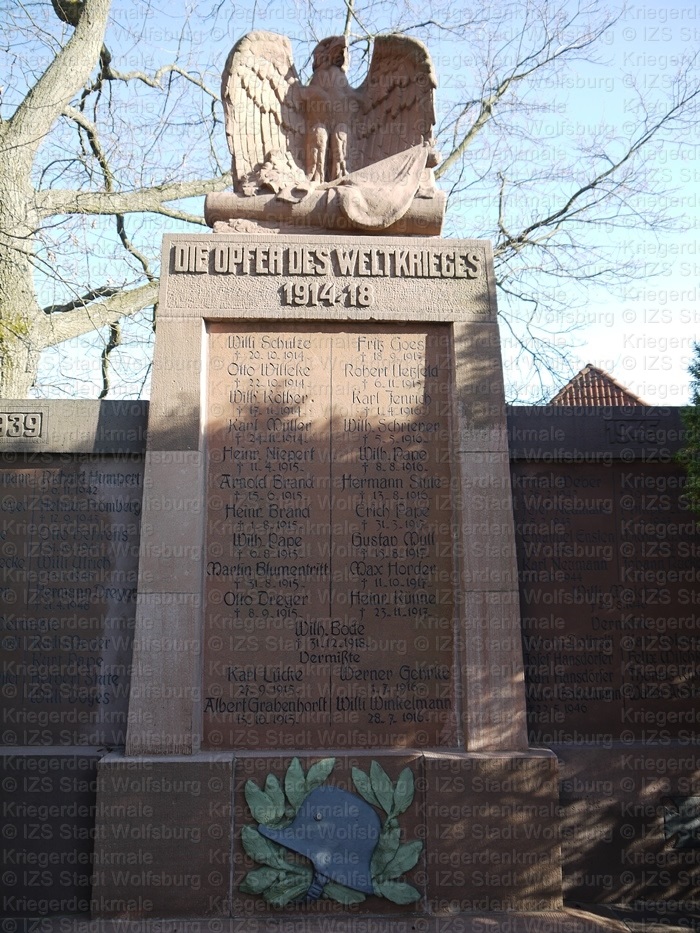
While oak leaves in Germanic mythology symbolize the unshakable courage displayed by those who fell on the battlefield, the cannon barrel underscores the unresolved conflict with France.
While the eagle was still regarded as a symbol of the united German people at the time of the founding of the German Empire in January 1871, its symbolic meaning shifted after 1918 in reactionary circles to become an emblem of German revanchism:[1] As an expression of nostalgia for the bygone German Empire, it was at the same time a sign of the influence of conservative structures in the still-young Weimar Republic. It is no coincidence that it gazes westward with its head proudly raised toward France, the “hereditary enemy” of the time; at the same time, it has extended its talons and spread its powerful wings protectively over oak leaves, a gleaming flag, and the monument. It appears as though the eagle, like the Madonna, is watching over the town’s fallen soldiers.[2] Furthermore, the steel helmet serves to glorify the deaths of the soldiers from Almker, as—when paired with a laurel wreath (similar to the oak leaves)—it symbolizes the courage of the fallen who gave their lives for the “German Fatherland.”
Unfortunately, no records regarding the monument’s establishment have survived. Nor do the local newspapers mention this event, which was so significant for the village. This makes the two photographs of the war memorial’s dedication—which Councilman Joachim Sievers made available to the Institute for Contemporary History and Urban Presentation in 2017—all the more valuable. They convey a striking picture of the enduring influence of militarism in the young Weimar Republic.
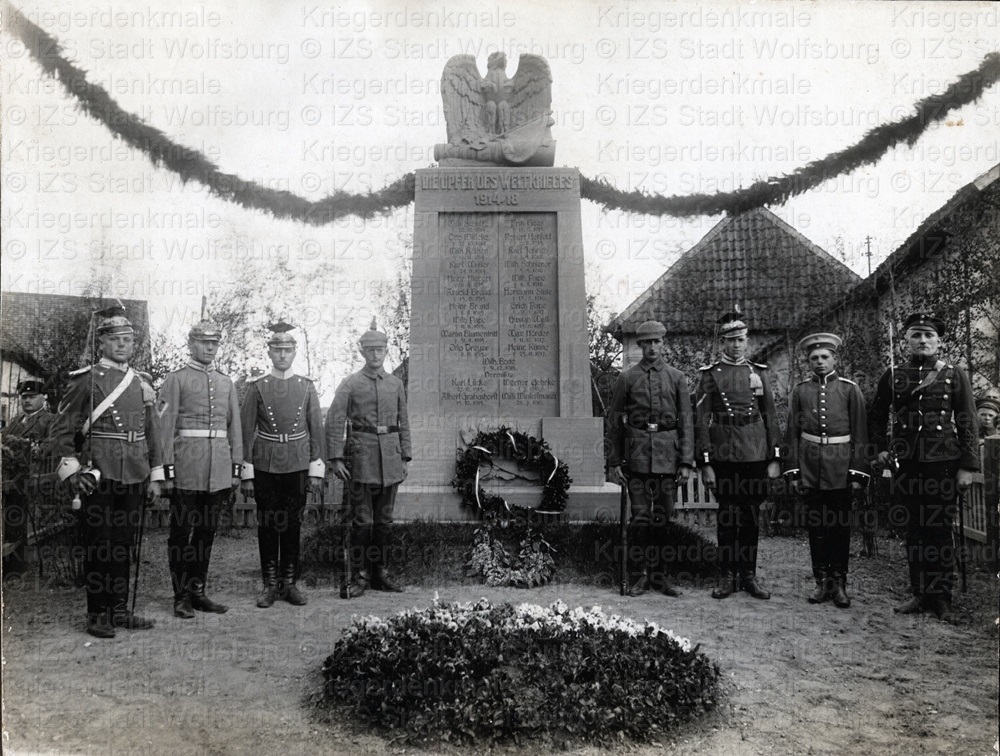
The first photograph appears to have been initiated by the Almke Landwehr Association itself. It was quite obviously staged by the photographer and shows four men in military uniform on each side of the monument, all looking directly at the camera. With the heels of their marching boots clacked together, the butt of their repeating rifles resting on the ground, and the barrel held in their right hands, a soldier dressed in a plain field-gray tunic marks the beginning of each row extending from the monument. Based on their distinctive headgear—a so-called chapka adorned with a golden Peninsula emblem in the shape of the double-headed imperial eagle—three of the remaining six soldiers can be identified as former Royal Uhlans. Similarly, the sword knot on the hilt of the sword held by the soldier at the end of the left row suggests that he served in a cavalry regiment. The focal point of the image is the memorial, adorned with wreaths and garlands.
According to the minutes of the Almke Landwehr Association, this “[in der] ” was formed following a previous meeting on August 18, [Mai 1922].[3] The 24 men, including former soldiers of the German Imperial Army, dedicated themselves to preserving “[n] ’s old comradeship” and to “supporting the surviving dependents of fallen comrades.” Barely two months later, the association adopted the standard bylaws of the right-wing conservative Kyffhäuser League ([4] ) , whose goals included, among other things, the continuation of militaristic traditions and the fight against the “Versailles Treaty.” With this, the Almke Landwehr Association officially became part of the German Imperial Veterans’ Association “Kyffhäuser.” This is further evidence of the continuity of militarism and the persistence of “authoritarian and anti-democratic structures” in the Weimar Republic [5] —particularly in rural regions.[6]
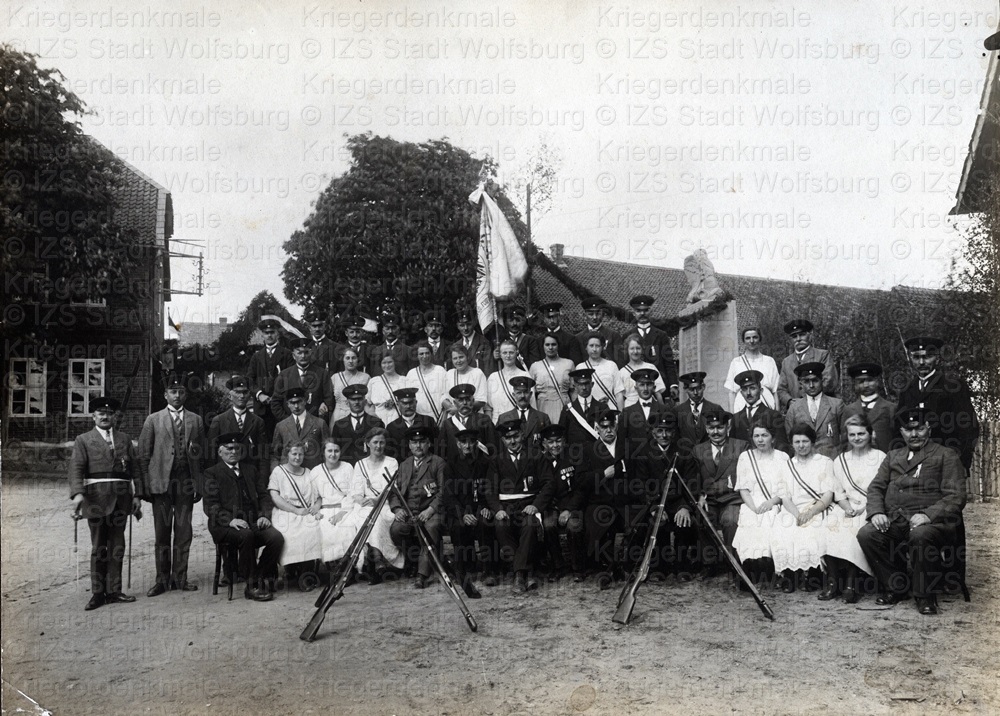
A second historical photograph depicts the day of the veterans’ association’s flag dedication ceremony and corresponds with the first. Taken on May 14, 1923—just before the first anniversary of the association’s founding—the photograph shows 36 men and 15 women dressed in white, arranged in four staggered rows standing to the side of the monument. To emphasize their loyalty to Prussia, they are all wearing black-and-white-and-black sashes. The 36 men, most of whom are wearing field caps with cockades and some of whom are decorated with medals, look cheerfully toward the camera with their heads held high. Centrally positioned in the bottom row, with a sash tied around his hips: Hermann Niebuhr, vice president of the Landwehr Association and a former royal uhlan during World War I. Visible in the center above the rows: the consecrated flag. On this very flag, one can make out a black-colored eagle framed by oak leaves. To the left of it, fluttering in the background to emphasize the right-wing conservative stance, is the flag of the defunct German Empire. In front of the first row, four carbines are leaning against each other on the left and four on the right—precisely the type of rifles predominantly used by the German infantry during the war. Thus, this photograph also documents the social significance of militarism, which had solidified and become established in the wake of the wars of unification in the 1860s and early 1870s. Hierarchical structures from the military, such as the ironclad principles of command and obedience, extended to all levels of society—even into education.[7] It can therefore be assumed that the symbols used on the Almker memorial—such as the eagle or the steel helmet—were easy for viewers to decipher.[8] The special status of the military and the glorification of soldiering [9] persisted in Germany within right-wing conservative circles well beyond the end of World War I. – After World War II—the exact date has not yet been determined—the Almker Memorial was expanded to include two simple side wings commemorating the Almker soldiers who fell in that war. These same wings also bear the names of at least four soldiers who, as early as the 1920s, posed in front of the memorial in honor of their fallen comrades.
In February 1947, the state of Prussia ceased to exist “as the bearer of militarism and reaction in Germany” following the enactment of Control Council Law No. 46. Identified by the Allied victorious powers as the source of war propaganda that had spread over decades and across three forms of government, the dissolution of the state was intended to bring about a break within German commemorative culture and thus prevent the continued influence of reactionary structures, as had happened after 1918. At that time, the first veterans’ associations were formed just a few weeks after the revolutionary events of November 9. The Allies took early action to counteract any possible recurrence: Having been absorbed into the SA reserve regiments in the mid-1930s, the various veterans’ associations were considered part of the dismantled NSDAP apparatus and were therefore legally barred from being reestablished as of October 1945. While after World War I, the “stab-in-the-back myth” and the widespread myth of the “army undefeated on the battlefield” still allowed misguided spirits to haunt the Weimar Republic and fuel German anger, the postwar reality in 1945 was different: The Wehrmacht had simply been defeated. Consequently, a seemingly innocent culture of remembrance, distanced from militarism, took hold. Reserve and silence became the legacy of German postwar revanchism.
Sources:
[1] Meinhold Lurz, War Memorials in Germany. Volume 4. The Weimar Republic. Heidelberg 1985, p. 241.
[2] Ibid., p. 242.
[3] Almker Minutes Book from the collection of Joachim Sievers; founding of the association in May 1922.
[4] Ibid., 2nd Regular General Assembly of July 16, 1922.
[5] Geoff Eley, Wilhelminism, Nationalism, Fascism. On Historical Continuity in Germany. Münster 1991, p. 209.
[6] Sabine Behrenbeck, “Between Mourning and Heroization: Dealing with War Deaths and Defeat after 1918,” in: Jörg Duppler/Gerhard P. Groß (eds.), The End of the War in 1918: Event, Impact, Aftermath. Munich 1999, pp. 315–339, here pp. 323f.
[7] Emilio Willems, Prussian-German Militarism: A Cultural Complex in Social Change. Cologne 1984, p. 92.
[8] See also Jens Jäger, “Reflections on a Historiographical Image Analysis,” in: *Historische Zeitschrift*, vol. 304 (2017), pp. 655–682, here p. 674: The “conventional meaning [...] arises from the depiction of an everyday and well-known act—[as] —of disembarking from a ship, the recognition of the protagonists, the inextricably linked accompanying text, the location of publication, and the knowledge current at the time.”
[9] Manfred Messerschmidt, Militarism, War of Annihilation, Political History. On German Military and Legal History. Paderborn/Munich/Vienna/Zurich 2006, p. 4.
Published on November 7, 2018