
War Memorial Old Wolfsburg
By Maik Ullmann
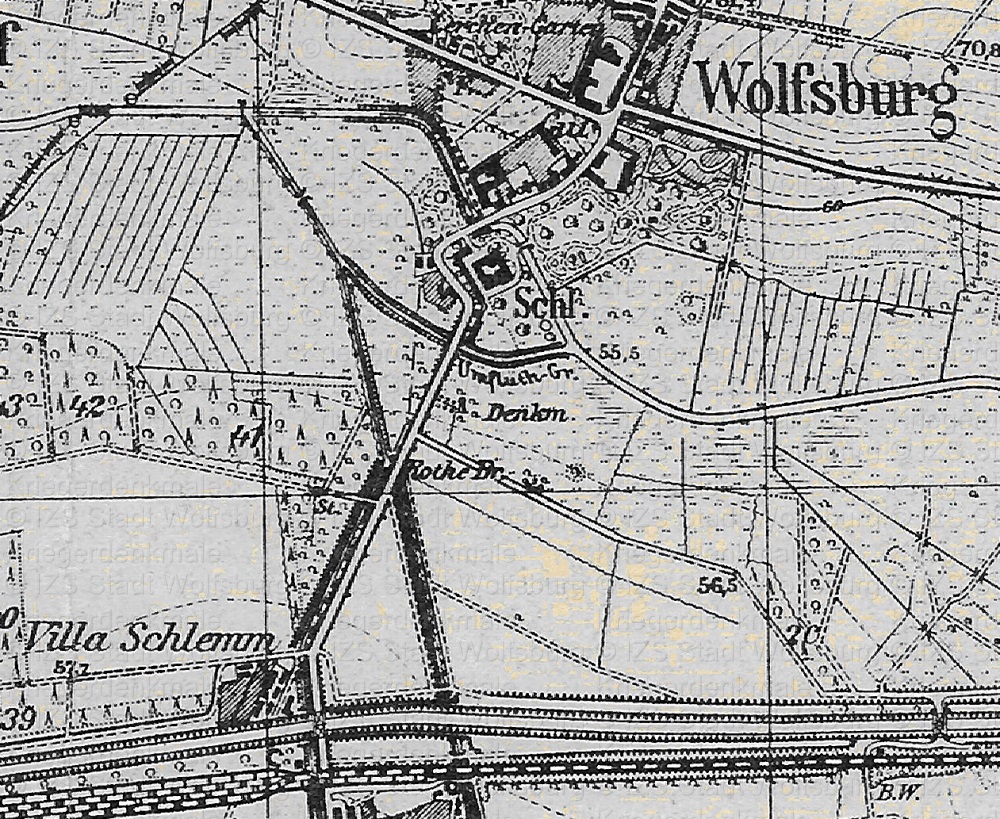
Surrounded by parking garages, located directly on the multi-lane B 188 and thus directly on one of the city's main traffic routes, the Old Wolfsburg War Memorial can be found on the grounds of the Volkswagen plant. At the end of a path leading off from the "Schloss" bus stop, surrounded by the constant change of shifts and lively automobile traffic, the memorial looks like a forgotten relic from the time of the Weimar Republic. But this was not always the case: more than 15 years before the founding of the "City of the Kdf-Wagon near Fallersleben", the memorial, embedded in the middle of the oak grove created at that time, was centrally located between the villages of Heßlingen, Rothenfelde/Rothehof and Wolfsburg Castle. At that time, the settlements and the farmstead were still connected by a wide road, from which the memorial site, situated on a meadow, could be reached via a branch. Situated in the middle of nature, the memorial was not only a silent place of remembrance, but also present in the everyday life of the population.
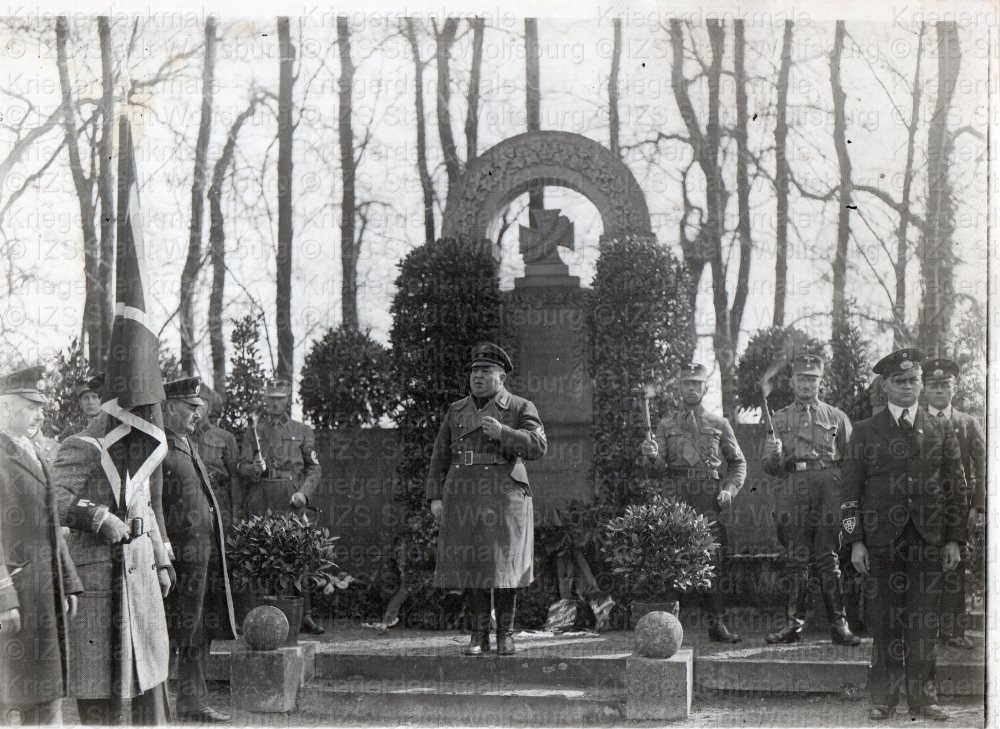
“I Had a Comrade” —sung by the Heßlingen Men’s Chorus, the soldiers’ song “Der gute Kamerad” (The Good Comrade), with lyrics written by Ludwig Uhland in 1809, served as the musical opening to the dedication ceremony for the memorial erected in Alt-Wolfsburg in honor of those who fell in World War I. As the words of the final verse were sung, the memorial was unveiled before a large gathering of attendees in a ceremony bathed in bright sunshine. The ceremony concluded with a wreath-laying by Count Werner von der Schulenburg (1857–1924) and Countess Frieda, née Baroness vor dem Bussche-Ippenburg (1871–1949).
As is not uncommon for agrarian regions, the towns and villages bordering Wolfsburg Castle were scarcely affected by the social transformation processes triggered by the end of the German Empire. The canon of virtues and values remained largely valid among the local population.[1] It is therefore not surprising that the ceremony held in the early afternoon of May 14, 1922, was conducted entirely in a nationalistic-conservative vein. Neither the deaths of German frontline soldiers—which circles on the political left generally regarded as senseless—nor the suffering of the bereaved found a place here. Instead, the fallen soldiers’ unconditional loyalty to the fatherland was invoked, and the responsibility of future generations to save Germany from ruin was emphasized. The statement by Professor Bröckler, chairman of the district veterans’ association and also the architect of the monument, was particularly poignant: “And even if we do not live to see the chains imposed upon us break, we still owe it to our dead [...].”[2] With this metaphor, Bröckler was ultimately alluding to nothing other than the Treaty of Versailles—perceived as a “gag contract”—which was followed by a period of inflation and economic decline. The scarcer food and work became, the more rapidly discontent grew among the population. Right-wing conservative and reactionary forces knew how to exploit that bitterness. The often-lamented “humiliation of Versailles” became a symbol of the oppression of the German people.
During the celebrations marking the dedication of the monument in Old Wolfsburg, Count Steinhof, the administrative director—himself a member of the monument committee—also appealed to the patriotic loyalty of all those present, drawing on Friedrich von Schiller’s play *William Tell*: “Join yourself to the fatherland, to the dear fatherland; hold fast to ‘[as] ’ with all your heart. Here lie the strong roots of your strength.”[3]
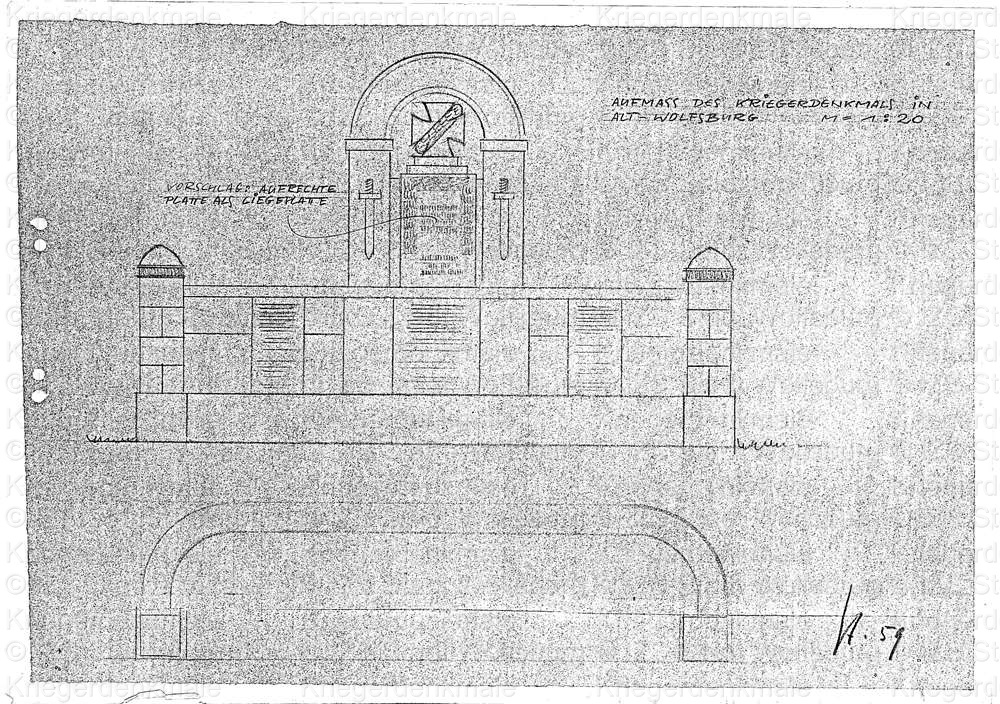
Built on the south side of the castle and set amid an oak grove planted at the time the monument was erected—[4] —the war memorial is an example of the cost-effective neoclassical architectural style often chosen in the region around Wolfsburg Castle. Framed on the right and left by pillars decorated with strips of oak leaves, a wall approximately one and a half meters high forms the base for an arch supported by columns. Three commemorative plaques are embedded in the walls, on which are carved the names of the soldiers from Heßlingen, Rothehof-Rothenfelde, and the Wolfsburg farmstead who fell in the war. A sword standing on its tip can be seen on both columns; between the two swords, a vine stretches across the arch. Protected by the arch’s structure, a fourth commemorative plaque adorned with an Iron Cross protrudes from the center, bearing the monument’s central message: “You gave your lives for the fatherland Life shall be yours.” Below the centrally positioned Iron Cross, entwined with laurel, the inscription continues: “In the World War 1914–1918 They died for their country.” This is followed by the three name plaques listing a total of 49 fallen soldiers.
Above the fourth panel is a Grand Cross of the Iron Cross encircled by a wreath. As the highest of all Prussian honors for acts of valor in war, this special form of the Iron Cross—adorned with an imperial crown, a “W” standing for Wilhelm II, and the year 1914—has been awarded to only twenty people in its history, including Gebhard Leberecht von Blücher, Edwin von Manteuffel, and Paul von Hindenburg. It is possible that the glory of this special award was also intended to be bestowed upon the fallen rank-and-file soldiers on the front lines. The inclusion of this special form of the Iron Cross stands in stark contrast to the classicist monuments, which are otherwise mostly characterized by “simplicity and dignity” [5].
Both the two swords and the Iron Cross are characteristic of the milieu-specific culture of remembrance [6] during the early Weimar Republic. These symbols add another component to the memorial’s already military character: the cult of the fallen. The resulting heroization of fallen German soldiers was one of the central themes of the national-conservative camp.[7] The laurel leaves are dedicated to what, according to this interpretation, was their heroic service to their fatherland—for which they paid with their lives. In the mythical Germanic tradition, they symbolize bravery. In this sense, they correspond to the Iron Cross, which was itself awarded as a decoration for particularly brave acts during wartime. The group of oak trees is also among the Germanic motifs.[8] While such “hero groves” were often used as substitutes for gravestones, there is no evidence that this was the case for the Old Wolfsburg Memorial. Rather, the grove here symbolizes a Germany rising up, freed from every yoke, just as Professor Bröckler called for in his speech.
The devastating consequences of World War I for a small town like Heßlingen—which had exactly 342 residents in 1910—are evident from an entry in the local school chronicle made by the town’s teacher, Willy Reinemund, on February 16, 1926: “1922 — 105 children / 1923 — 90 children (decline in births due to the war).”[9] As many as 20 men from the community had lost their lives in World War I.
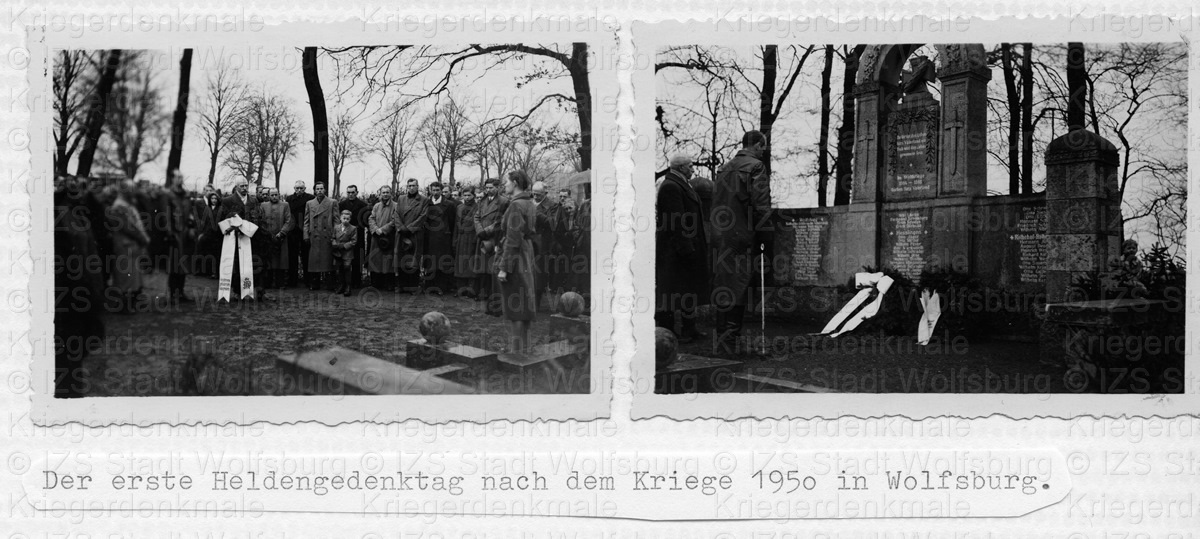
To pay final respects to the 56 soldiers from the communities of Heßlingen, Rothehof, and Rothenfelde who fell in World War II, four plaques were added on Sunday, November 16, 1975—International Remembrance Day—[10] on which their names are inscribed.[11] By that time, the citywide debate over relocating the memorial—which had arisen in the early 1950s as part of plans for a bypass—had long since died down.[12]

The proposed relocation to Piazza d’Italia or the castle park was shelved in August 1964 on the advice of the Building Department. This was also because “the benches in front of memorials in large parks serve as a refuge for vagrants and lovers [erfahrungsgemäß] [dienen] ,”[13] as pointed out by a building official who warned against both acts deemed immoral and unwanted visitors alike.
In the end, after years of debate, the memorial remained in its original location directly on the B 188, which is quite different today than it was when the memorial was inaugurated.
Sources:
[1] Benjamin Ziemann, “The Memory of World War I in the Milieu Cultures of the Weimar Republic,” in: Thomas F. Schneider (ed.), The Experience of War and the Creation of Legends. The Image of “Modern” War in Literature, Theater, and Film. Vol. 1. Osnabrück 1999, pp. 249–269, here p. 253.
[2] “Monument Dedication,” in: *Der Bote*, May 18, 1922.
[3] Ibid.
[4] “Monument Dedication in Wolfsburg,” in: *Aller-Zeitung*, May 23, 1922; StadtA Wob, HA 6278, Vol. 2, note: Re: Relocation of the Alt-Wolfsburg War Memorial, August 4, 1964.
[5] Meinhold Lurz, War Memorials in Germany. Vol. 4. Weimar Republic. Heidelberg 1985, p. 136.
[6] See also the text on the Vorsfelde War Memorial.
[7] Sabine Behrenbeck, “Between Mourning and Heroization: Dealing with War Deaths and Defeat after 1918,” in: Jörg Duppler/Gerhard P. Groß (eds.), The End of the War in 1918: Event, Impact, Aftermath. Munich 1999, pp. 315–339, here p. 316.
[8] Here and in the following, Lurz, War Memorials in Germany. Vol. 4. Weimar Republic (as in note 6), pp. 197ff.
[9] City of Wob, HA 3588, Vol. 1, Heßlingen School Chronicle, entry dated February 16, 1926.
[10] Susanne Brandt demonstrates that this was common practice in the Federal Republic of Germany in “Denkmalpolitik und Grabmalkunst 1919–1924,” in: Gertrude Cepl-Kaufmann/Gerd Krumeich/Ulla Sommers (eds.), Krieg und Utopie. Art, Literature, and Politics in the Rhineland after World War I. Essen 2006, pp. 389–393, here p. 389.
[11] “Ceremonies on Remembrance Day: Citizens Should Not Stand on the Sidelines,” in: *Wolfsburger Nachrichten*, November 14, 1975.
[12] “Building Department Received No Proposal,” in: *Wolfsburger Allgemeine Zeitung*, July 31, 1959; StadtA Wob, HA 8938, To Department IV in-house, Re: Planning for Old Wolfsburg, July 10, 1964.
[13] StadtA Wob, HA 6278, Vol. 2, Note: Re: Relocation of the Old Wolfsburg Memorial, dated August 4, 1964.
Published on November 7, 2018