
War memorial memorial stone Neuhaus
By Maik Ullmann
A fundraising campaign in Neuhaus in the early 1950s raised a total of 1,022 DM. Exactly 49 residents—out of a total population of about 320 in [1] —donated between 3 and 100 DM at the time to erect a memorial to the village’s fallen soldiers of World War II and those missing in action.[2] To identify these individuals, those in charge relied on the help of the local community. Mayor Karl Schaare [3] wrote in an undated appeal to the public: “We need […] the exact names, as well as the dates of birth[-] and death, and where they were killed in action or went missing. (Don’t forget their rank, either).”[4] As a result, the municipal council received a total of 16 letters. As a result, a memorial stone was commissioned from the Werkstätte für Grabeskunst in neighboring Vorsfelde, which was erected in the fall of 1953 by sculptor Martin Voll and the municipality.[5] It was placed in front of a boulder. In addition to the names, the dates of death of the fallen Wehrmacht soldiers were also inscribed on it. Not atypical for the time,[6] the monument was erected without any dedication ceremony on the part of the municipality. The erection of the memorial thus fits seamlessly into the picture that historian Christoph Cornelißen has painted of the early Federal Republic’s culture of remembrance: Among its dominant characteristics were, above all, “modesty, restraint, and silence.”[7] This was evidently also the case in Neuhaus.
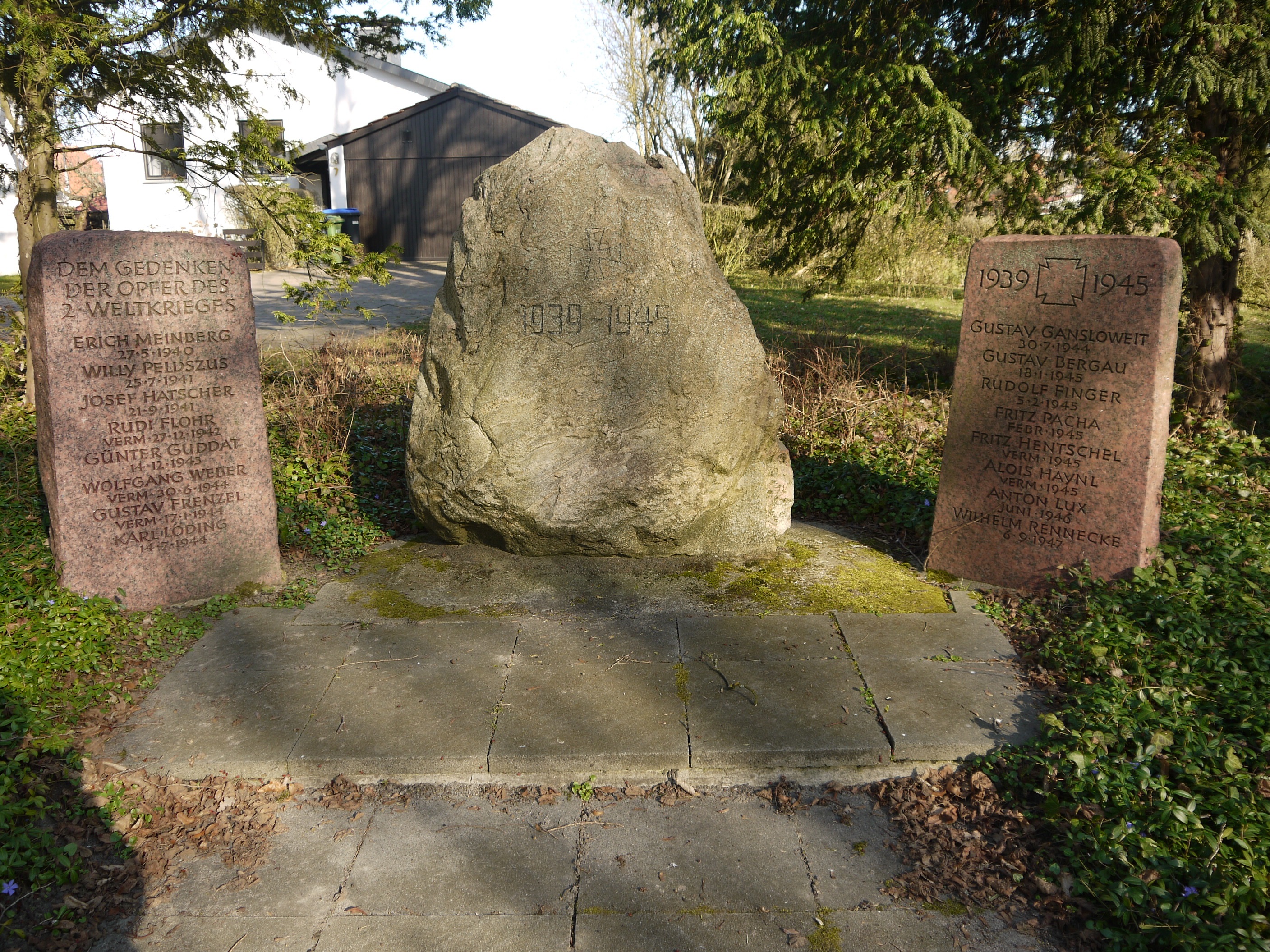
This was still the case in November 1989, when the completely renovated memorial to those killed and missing in World War II was dedicated on November 19, 1989, on Neuhäuser Burgallee.[8] However, this redesign received no media coverage at any point. This is hardly surprising, given that just a few days earlier, on November 9, the fall of the Berlin Wall had marked the symbolic starting point for German reunification. Accordingly, local newspapers reported on the more than ten thousand East German citizens who, on the weekends during those days, took advantage of their newfound freedom to take a trip to Wolfsburg.
The redesign was preceded by a discussion in the local council that began in the late 1980s, which addressed the monument’s neglected condition. In the summer of 1988, the administration finally deemed it necessary to clean the monument and commissioned the company Naturstein Billen KG to do so.[9] However, the steam-cleaning process did not achieve the desired result. As a handwritten note indicates, the matter was to be reconsidered: “Since cleaning the existing stones did not yield the expected results, the administration will reevaluate the restoration of the monument.”[10] The local chapter of the Christian Democratic Union (CDU) took the lead in this matter. Ultimately, a red-brown granite memorial stone was added to the right and left sides of the boulder, and a five-figure sum was invested in its installation. However, the inscription on the memorial stone—proposed by the administration and approved in consultation with the cultural committee—is problematic: “In Memory | Of the Victims | Of World War II.”[11] The inscription is followed by a list of the town’s war dead, arranged by year of death. This gives rise to a dialectic typical of the CDU’s party platform: Founded after the end of World War II as a party for Christian-social and conservative-oriented non-perpetrators,[12] the Neuhaus CDU faction has here, in the name of the fallen, engaged in a posthumous “self-attribution of victimhood.”[13] In the context of World War II and the history of National Socialism, however, the concept of “victim”—as established in academic and political discourse—contrastingly encompasses only those who were discriminated against, persecuted, and murdered by the Nazi regime.[14] Although German—civilian—victims were increasingly included in the discourse in the early 2000s, the focus has been—and continues to be—less on Wehrmacht soldiers and more on people displaced from their homes and victims of the bombing campaign.
Sources:
[1] City A WOB, No. 4, Quarterly Report on Population Changes as of April 1, 1951.
[2] WOB City Archives, Neu. 22, Memorial to the Fallen, list of donations for the construction of the memorial in the municipality of Neuhaus. Undated.
[3] City Archives WOB, Neu. 1, Municipality of Neuhaus to the Helmstedt Municipal Supervisory Office. Re: Circular No. 208/52 dated December 7, 1952.
[4] WOB City Archives, Neu. 22, The mayor to the municipality of Neuhaus. Undated.
[5] StadtA WOB, Neu. 22, Martin Voll to the municipality of Neuhaus, dated October 28, 1953.
[6] See also the article by Maik Ullmann, “The Instrumentalization of Commemoration Culture: How Right-Wing Conservative Forces Exploited Mourning Through the Vorsfeld Memorial,” in: Das Archiv. Journal of Wolfsburg City History, Vol. 2 (May 2017), #005, pp. 10ff.
[7] Christoph Cornelißen, “Cultures of Remembrance in Stone: National Monuments in Democracies Since the American Revolution,” in: Hans-Joachim Veen/Volkhard Knigge (eds.), Monuments of Democratic Upheavals After 1945. Cologne/Weimar/Vienna 2014, pp. 37–60, here p. 55.
[8] StadtA WOB, HA 10132, Vol. 1, meeting notes from the Neuhäuser local council members Kowalewski and Flohr and representatives of the City of Wolfsburg dated November 2, 1989.
[9] StadtA WOB, Neu. 22, letter from Naturstein Billen KG to the Building Department of the City of Wolfsburg dated June 29, 1988.
[10] StadtA WOB, Neu. 22, handwritten note. Undated.
[11] StadtA WOB, Neu. 22, Renovation of the memorial in the Neuhaus district, dated July 11, 1989.
[12] Petra Hemmelmann, The CDU’s Compass: An Analysis of Policy and Election Platforms from Adenauer to Merkel. Wiesbaden 2017, p. 144.
[13] Lars Breuer, Communicative Memory in Germany and Poland: Images of Perpetrators and Victims in Discussions about World War II. Wiesbaden 2015, p. 171.
[14] Heidrun Kämper, The Discourse on Guilt in the Early Postwar Period. A Contribution to the History of Linguistic Change after 1945. Berlin 2005, p. 18.
Published on November 7, 2018