
War memorial Germania Fallersleben
From Maik Ullmann
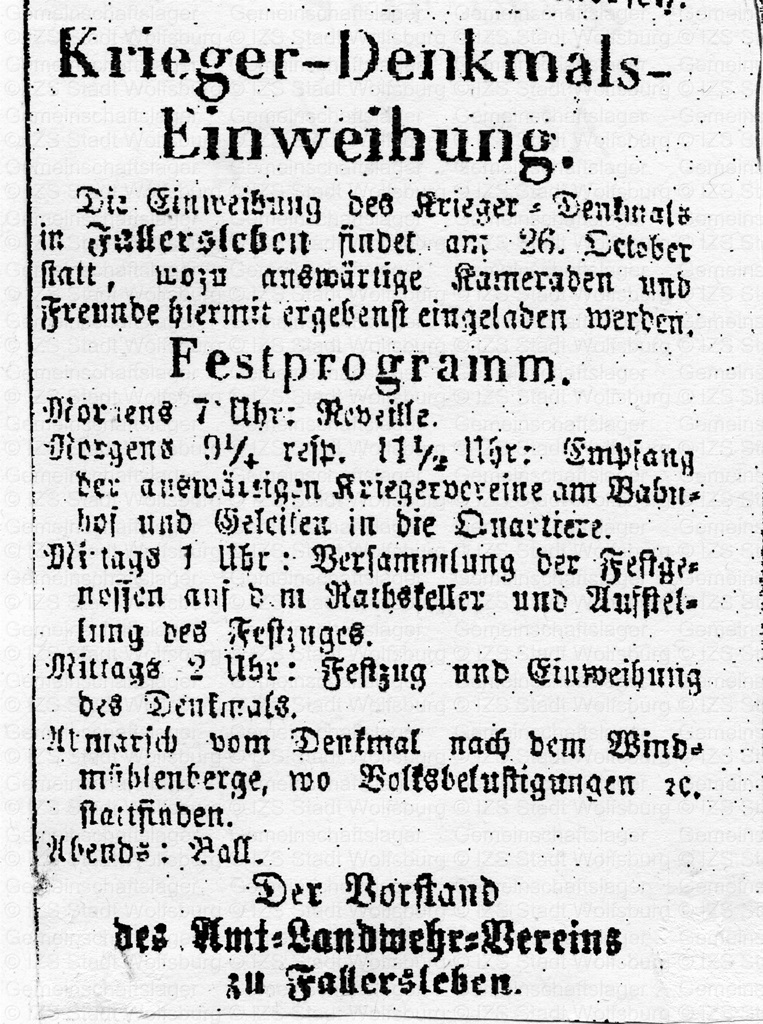
An urn once stood atop the pedestal of the Waterloo Monument in Fallersleben, but it was replaced by a statue of Germania on October 26, 1876. From then on, the monument—dedicated on June 8, 1817, to the Battle of Waterloo and its fallen—was also intended to commemorate “the glorious victories of 1870–1871,” as the Aller-Zeitung noted on November 3, 1876.[1] With the construction of the monument—the costs of which were largely borne by the local population and the local Landwehr association—[2], the community sent a striking signal of its allegiance to the German Empire. In this context, the Germania figure serves as an expression of nationalism, as was ultimately evident during the dedication ceremony: Whether through the raising of the German flag by the citizens of Fallersleben, the arrival of representatives from numerous veterans’ associations, or the organization of a torchlight procession [3] —the contributions to the large-scale unveiling of the monument took many forms.
The figure of Germania, created by the Halle-based sculptor Emil Schober [4], was thus also intended to commemorate the Franco-Prussian War, at the end of which the German Empire was proclaimed in the Hall of Mirrors at Versailles. For this very reason, the Germania statue nearly disappeared from Wolfsburg’s landscape of monuments after the war.
For the Potsdam Agreement of August 2, 1945, established the denazification and demilitarization of Germany as two essential points of the agreement. The consequences of this agreement reached by the victorious powers were clearly felt within postwar German commemorative culture—including in Fallersleben. In an order dated August 26, 1946, the military government of the Gifhorn district required its municipalities to immediately report all monuments and museums intended to “revive militarism or commemorate the Nazi Party.”[5] In addition to the Waterloo Monument, a memorial stone for those killed in World War I, a glass memorial plaque for firefighters killed in the same war, and a captured cannon from 1915, the then-City Manager of Fallersleben, Daniel Hill, also listed the Germania statue standing on the memorial square. A committee appointed by the municipality even proposed its removal. Only the pedestal was to remain.[6] According to a brief note dated December 20, 1946, however, “no further decision has been made to date.” The correspondence on this matter ends here; the Germania statue still stands in its original location today.
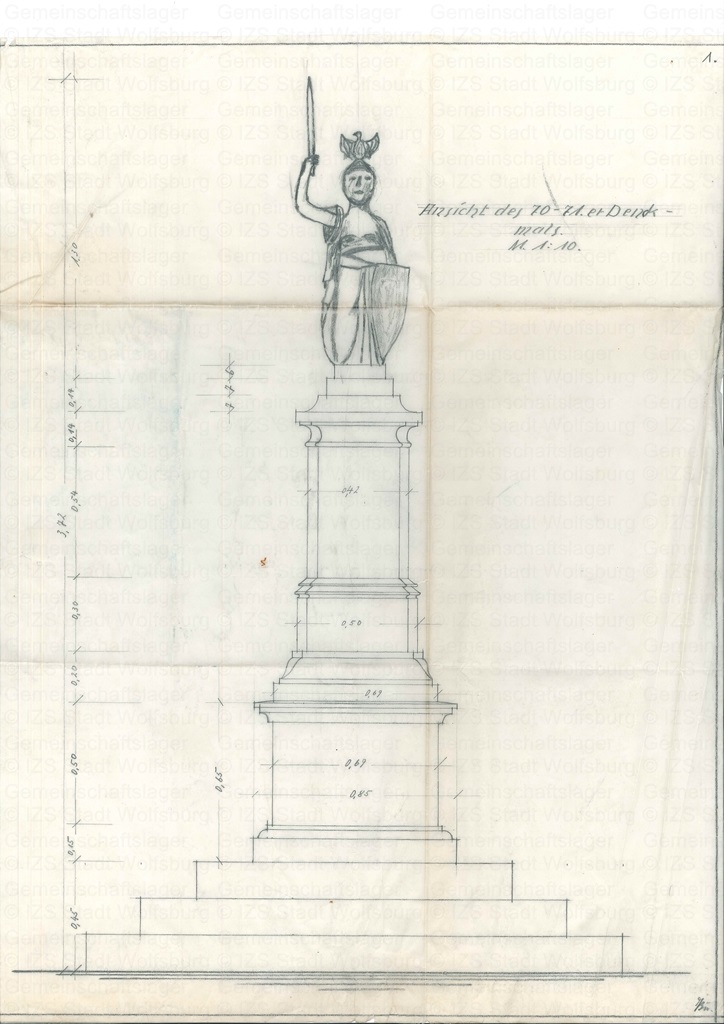
The reasons for this likely lie in a redesign of the monument that had already taken place on May 12, 1932, although the specific circumstances of that redesign can no longer be determined. On that day, the Germania statue was given a new pedestal—the old pedestal of the Waterloo Monument was moved to the palace park, where it could once again stand on its own in its original form.[7] The new Germania pedestal, in turn, no longer commemorated “the glorious victories” but bears the following inscription: “To the brave heroes from their grateful fellow citizens.” In addition, in 1932, the names of the 25 soldiers from Fallersleben who had gone to war against France in 1870–71 were inscribed on the pedestal. The Iron Cross, encircled by a laurel wreath, was ultimately dedicated to them and their service in battle. According to the list, none of the soldiers lost their lives during the fighting. However, the Fallersleben council minutes indicate that “a miller’s apprentice” [8], was killed in the course of the battles. This individual was “Th. Lehn,” who is marked on the pedestal as “wounded,” but who, according to the “Amt-und-Landwehrverein,” had actually been killed in action.[9]
But what is the story behind the symbol of Germania itself? Revived in the late 18th century, it underwent numerous reinterpretations until 1945. The figure proved to be a malleable medium that was repeatedly adapted to the prevailing ideology of the time.[10] While she was still regarded as an anti-monarchical, bourgeois symbol in the years leading up to the Wars of Liberation, she was transformed in 1814 by the Prussian King Frederick William III into a monarchical-patriotic allegory.[11] Yet it was the Roman historian Tacitus—rediscovered only during the Renaissance—who would have a decisive influence on the modern reception of Germania. It was the customs he described, particularly the morality of the Germanic peoples, that were repeatedly invoked in the 19th century. In the effort to consciously distinguish themselves from other nations, Germania was an indispensable construct for the newly emerging national consciousness: The Germans sought a symbol that could express their identity and the unity they had forged. It was the figure of Germania that fulfilled precisely this purpose.[12] After the founding of the German Empire, in the course of planning the massive Niederwald Monument—which was intended to be a demonstration of German unity—the national symbol underwent a renewed reinterpretation. While in the 1860s she was depicted as looking toward France in a rather warlike and admonishing manner, after 1871 she was predominantly portrayed in a victorious pose and adorned with the imperial insignia.[13] The monument’s character was now less militaristic; rather, as a national monument, it commemorated the founding of the German Empire.
Since the Germania statue in Fallersleben was erected during the 1870s, it makes sense to view it in this context: With the imperial eagle resting on her head and her sword triumphantly raised toward the sky, she gazes proudly toward the north, in keeping with her mythical origins. The chosen direction—which deliberately contrasts with earlier depictions in which she looked westward—makes it clear that the war was history and that the people were living in peace with France.[14] She had now finally cast off the burden of the chains, once imposed by the Romans and later again by the French: Germania was completely freed from every yoke. The same was true for the individual German states. It was only the victory over France in the spring of 1871 that made possible the founding of the German Empire, free from any foreign rule. Thus, the Germania of Fallersleben is to be interpreted as a symbol of the peace that had been achieved, a symbol further emphasized by the laurel branch adorning her head.[15]
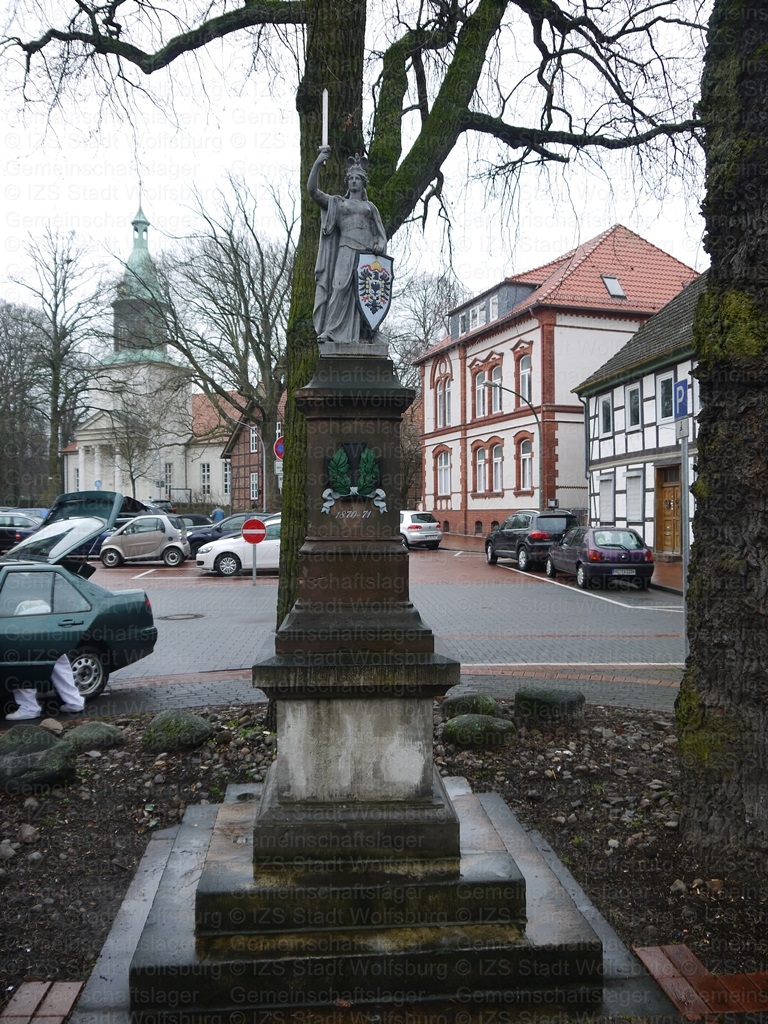
Germania is clad in a sagum, a type of Roman cloak that Tacitus mistakenly considered characteristic of the Germanic peoples.[16] A breastplate worn over it protects the upper body. While later depictions of Germania once again show her with a raised shield, awaiting the enemy in a warlike stance, the Fallersleben Germania simply holds the lowered shield by its upper edge with her left hand, as if she were aware that she would not have to fend off any adversary in the near future. It features not only the Prussian eagle but also the golden imperial crown. According to legend, it dates back to the imperial coronation of Otto the Great in the 10th century.[17] In the late 19th century, due to this supposed line of continuity, it was regarded as the embodiment of the imperial ideal according to God’s will. The shield is designed in the colors of the German Confederation and the later imperial colors of black, white, and red. Fallersleben gave visible expression to the growing sense of unity among the now pan-German population by placing three oak trees to the left, right, and behind Germania. For in the Germanic tradition—to which German commemorative culture drew in countless variations—these were symbols not only of peace but also of various German virtues such as honor and courage.[18] This very point was made by the town’s superintendent at the time, August Althaus, in his speech at the monument’s dedication on October 26, 1876: The great war had “once again brought forth a strong German Empire and a German emperor.”[19] Nevertheless, he noted, the German people could not find their true life in war, but only in peace.
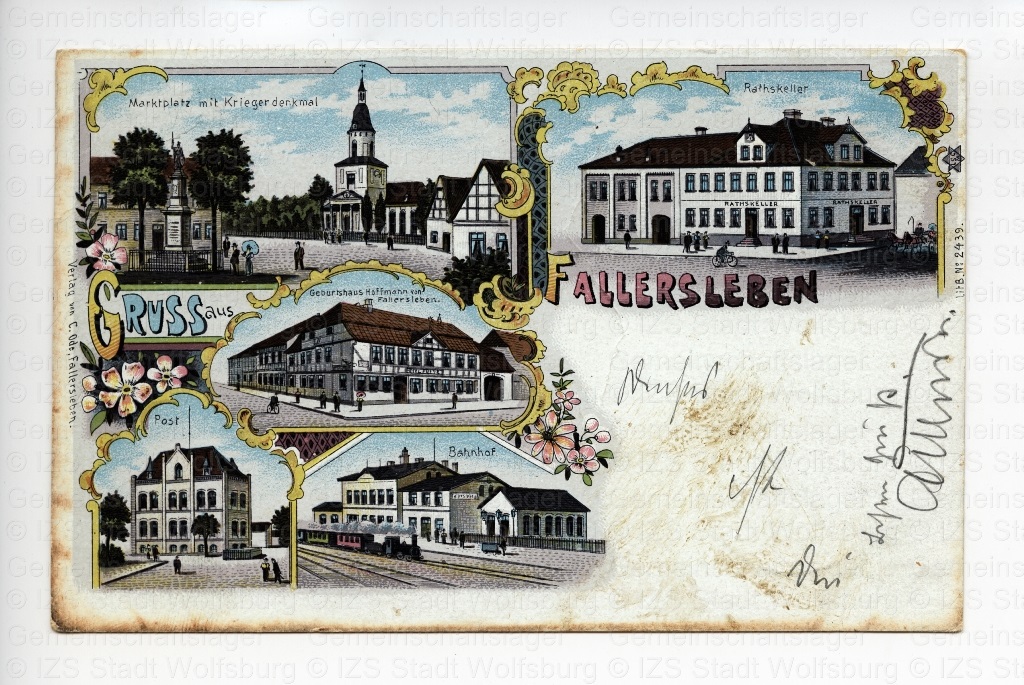
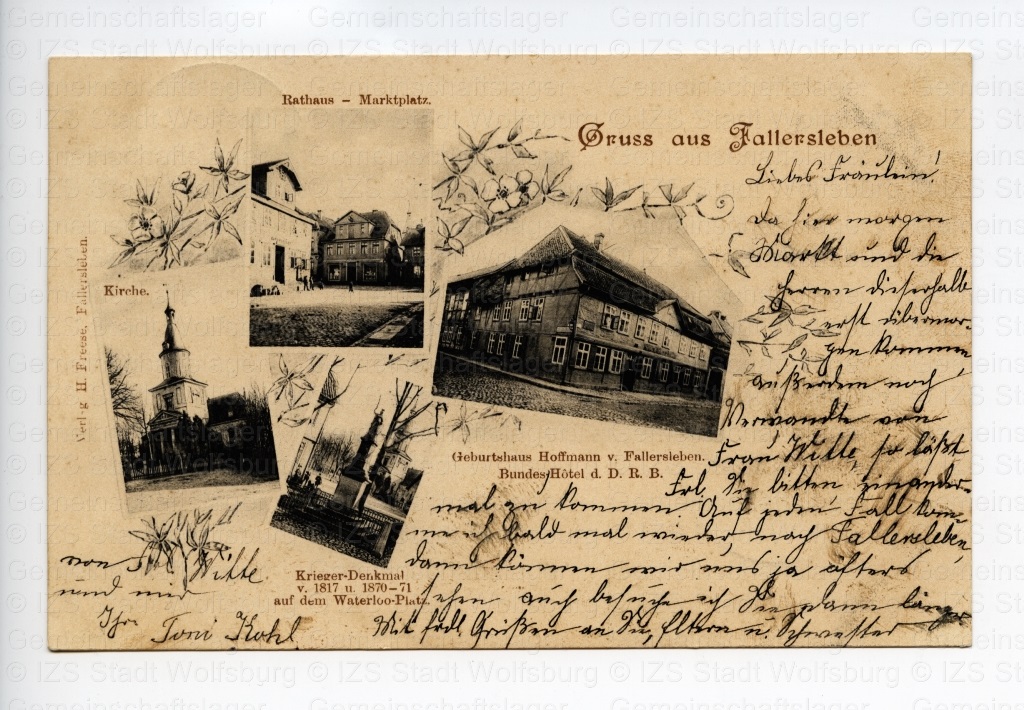
The Germania statue quickly became an established part of Fallersleben’s cultural heritage. In the late 19th and early 20th centuries, it appeared as a central motif on numerous postcards.[20] In today’s commemorative practices, however, it plays hardly any role at all. Over the course of 70 years, amid shifting ideologies and political structures, the mythical Germania largely lost its significance. The message it conveyed has also long since become obsolete: The era of the much-invoked supposed hereditary enmity with France ended in 1963 with the signing of the Élysée Treaty.
It was not until 1980 that the monument once again caused a stir: “Treasures Found for Historians,”[21], read the headline in the Wolfsburger Nachrichten on August 28 of that year. On August 18, the Germania statue was damaged under circumstances that can no longer be reconstructed today.[22] During the incident, a monument conservator discovered a scroll inside the statue,[23] which contained numerous documents.[24]
In addition to newspaper articles from the time of the monument’s groundbreaking and its redesign, these included 191 telegrams from the period between July 1870 and March 1871, which reported on the course of the war in France. In addition, a poster from the National Socialist German Workers’ Party regarding the election of the 7th Reichstag (1932)—featuring a portrait of Adolf Hitler—an early endorsement of National Socialism even before Hitler’s appointment as Reich Chancellor. At the time of their discovery, however, the documents did not receive any special attention.[25] They were simply returned to the casing, which in turn was placed back in its original location inside the restored Germania statue. No copies were made of the dispatches from the theater of war or the election poster, so parts of the “Germania File” must remain sealed for the time being.
Sources:
[1] “Fallersleben, October 27,” in *Aller-Zeitung*, November 3, 1876.
[2] City of Wolfsburg, The Council Book of the City of Fallersleben (as in note 5), p. 165; StadtA WOB, HA 9076, Fallersleben Civil Guard Association, News about the Monument, October 21, 1876.
[3] “Fallersleben, October 27,” in: Aller-Zeitung, November 3, 1876.
[4] Communication from Roland Kuhne, Halle City Archives, to the author dated October 27, 2016.
[5] WOB City Archives, HA 10843, Vol. 1, To the Mayors in the District, Re: Military Museums and Monuments, August 26, 1946; Ibid., Mayors in the District, Following up on my directive of August 26, 1946, October 4, 1946.
[6] Here and in the following, ibid., To the Gifhorn District, Re: Military Museums and Monuments, October 8, 1946.
[7] StadtA WOB, HA 9076, Handwritten note by Principal Heinrichs dated May 12, 1932.
[8] City of Wolfsburg (ed.), Annette von Boettcher (comp.), The Council Book of the City of Fallersleben. 1547–1948. Braunschweig 2013, p. 165.
[9] StadtA WOB, HA 9076, Amt-Landwehr Association of Fallersleben, News about the Monument, October 21, 1876.
[10] Lothar Gall, *Germania: A German Marianne?* Bonn 1993, p. 20.
[11] Meinhold Lurz, War Memorials in Germany. Volume 1: Wars of Liberation. Heidelberg 1985, pp. 177ff.
[12] Charlotte Tacke, Monuments in the Social Sphere: National Symbols in Germany and France in the 19th Century. Göttingen 1995, p. 29.
[13] Here and in the following, ibid., p. 179.
[14] Gall, *Germania* (as in note 10), p. 26.
[15] Simone Staritz, Gender, Religion, and Nation—Genoveva Literature 1775–1866. St. Ingbert 2005, p. 122; Gall, Germania (as in note 10), p. 18.
[16] Cornelius Tacitus, *De Origine Et Situ Germanorum*, 17, 1–2, ed. and trans. by Alfons Städele. Berlin 2011; Elke Trzinski, *Studies on the Iconography of Germania*. Recklinghausen 1990, p. 66.
[17] Hans Martin Schaller, “The Vienna Imperial Crown—Created under King Conrad III,” in: Society for Staufian History (ed.), The Imperial Regalia. Symbols of Authority of the Holy Roman Empire. Göppingen 1997, pp. 58–89.
[18] Meinhold Lurz, War Memorials in Germany. Volume 5: The Third Reich. Heidelberg 1986, p. 214; Ibid., War Memorials in Germany. Volume 1: Wars of Liberation (as in note 11), p. 154.
[19] Here and in the following, “Fallersleben, Oct. 27,” in: *Aller-Zeitung*, Nov. 3, 1876.
[20] StadtA WOB, Postcards, P-705, P-708, P-709, P-710, and P-711 (German Imperial Post. Postcard).
[21] “Treasures Found for Historians,” in: Wolfsburger Nachrichten, August 28, 1980.
[22] StadtA WOB, HA 9076, note by Elke Wichmann from the School and Cultural Affairs Office: Discovery of a scroll of documents in the “Germania” monument in the Fallersleben district, August 20, 1980, p. 1.
[23] Copies of the contents of the tube are now partly housed in the collection of the Hoffmann-von-Fallersleben Museum.
[24] WOB City Archives, HA 9076, note by Elke Wichmann from the Office of Education and Culture: Discovery of a scroll of documents in the “Germania” monument in the Fallersleben district, August 20, 1980, p. 1.
[25] Ibid., p. 2.
Published on November 7, 2018