
War Memorial Cross of the East Fallersleben
By Maik Ullmann
“We, the displaced persons, renounce revenge and retribution,” states the Charter of the German Displaced Persons. It was signed on August 5, 1950, by 30 representatives of the various regional associations and interest groups of displaced persons. It was intended to serve as a symbol of peace and, at the same time, to express acceptance of the Oder-Neisse Line established at the Potsdam Conference in August 1945. Just one year later, on August 5, 1951, the Federal Republic of Germany observed the first official “Day of the Homeland.” To mark this occasion, the Wolfsburger Allgemeine Zeitung published a foreword by Dr. Ohly, the first chairman of the Gifhorn chapter of the Central Association of Displaced Germans (ZvD). It states emphatically: “To the ‘Day of Potsdam’—the day on which the greatest crime against humanity was sanctioned by the will of the victors—we, the displaced, consciously counter with the ‘Day of the Homeland.’”[1] While Ohly eloquently denounces what he perceives as “victors’ justice” here, he concludes his letter by expressing the revisionist hope that “one day the dawn will break on a day when it is said: Ostland is ours again!” On that “Day of the Homeland,” at the initiative of the Fallersleben local chapter of the ZvD and the United East German Compatriot Associations, the memorial “For the Dead Among the Displaced from the East” was dedicated on Fallersleben’s Schlossplatz.[2]
The ceremony was preceded by a discussion and planning phase lasting about one year between the parish council, the town of Fallersleben, and the board of the local ZvD, at the end of which the following resolution was sent to the parish council in Fallersleben in June 1950: “The executive board of the local chapter of the Central Association of Displaced Germans, in agreement with the members of the ZvD, has decided to erect a memorial to be dedicated on ‘Homeland Day’ in October. This memorial is intended to honor the dead among the displaced persons—both those who fell in battle and those still buried in their former homeland—as well as the 2.5 million Germans who, having fled and been expelled from their former homeland, never arrived here and are missing.”[3] Of the approximately 5,000 residents of the town of Fallersleben in 1947, slightly more than 2,000 were displaced persons.[4] Accordingly, there was a strong desire within the community to create a memorial site that would serve as a place to channel the collective grief of the displaced persons and also function as a substitute for a cemetery. “[I]m Anblick der Kirche” (at the foot of the church), on the centrally located Schlossplatz, a wooden cross was to be erected for this purpose in accordance with the wishes of the ZvD.[5]
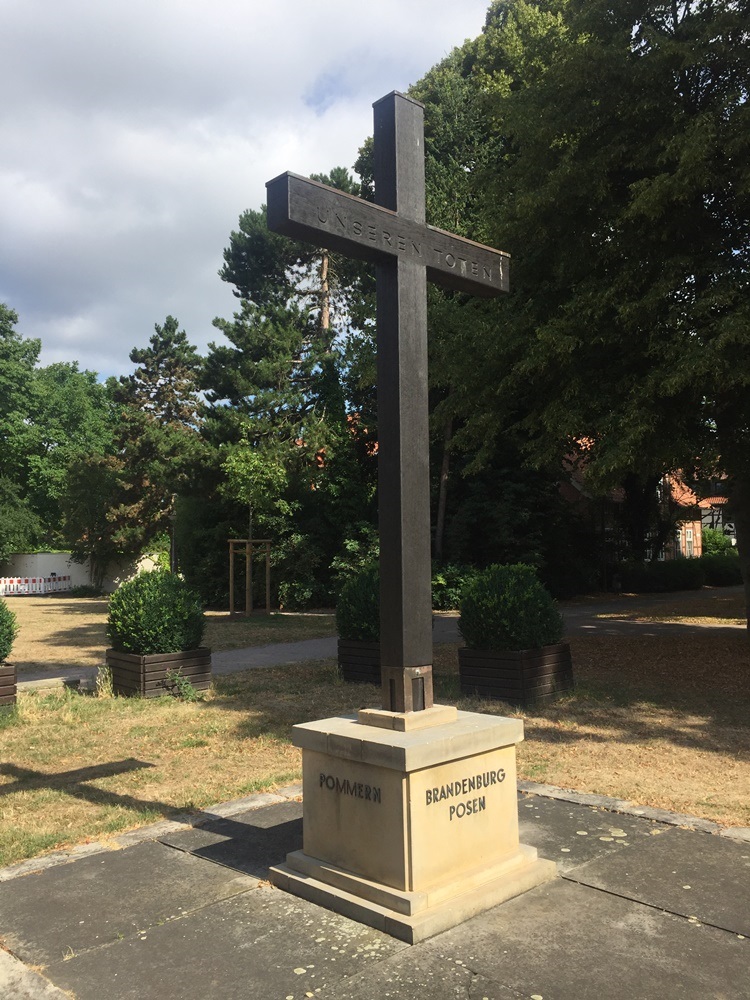
As places of quiet remembrance, it is not uncommon for memorials to displaced persons to be erected near churches or directly on church grounds.[6] The choice of location and the form of the memorial are, first and foremost, an expression of the displaced persons’ faith; furthermore, they embody the associations’ intention to erect both a memorial and a symbolic grave. The memorial was intended to commemorate the formerly German territories east of the Oder-Neisse Line, which it was hoped would one day be reclaimed as part of Germany. It also served to honor the dead whose graves now lay within the borders of Poland and, as was often claimed, had allegedly been converted into “potato fields and construction sites.”[7] Both aspects find written expression in the monument’s inscriptions: The crossbeam of the oak cross bears the inscription in gold-leaf block letters: “The Displaced to Their Dead.” In addition, the four sides of the natural stone block list four formerly German provinces: East Prussia, Pomerania, Silesia, and West Prussia.
As the minutes of the Fallersleben council meeting on August 22, 1950, initially suggest,[8] Mayor Karl Heise, the Building Committee, and the refugee representatives had suddenly agreed to relocate the “oldest Waterloo monument in the Province of Hanover,” rebuilt in 1932[9], to the Kanonenplatz [10] on Hoffmannstraße in favor of the “Memorial to the Dead[s].”[11] However, as evidenced by the minutes of a meeting of the Construction, Finance, and Administration Committee on September 1, 1950, concerns were subsequently raised within the council: After Councilman Böllhoff had spoken in favor of keeping the monument in its current location, Mayor Heise decided to postpone the decision until September 4 to allow meeting participants to visit the castle park beforehand.[12] That inspection committee, consisting of several councilmen and “refugee representatives,” unanimously decided following this visit to erect the memorial on the “church square between the red beech and the plane tree.”[13] However, this decision was also revised three weeks later. The Fallersleben superintendency of the Evangelical Lutheran St. Michael’s Church expressed concerns—citing “the significance of the memorial”— [14] and attempted to prevent its installation on the church square. The letter does not specify what these concerns were in detail. It cannot be said with certainty whether this decision was based on denominational motives, given that the cross, as a form of memorial for displaced persons, was widely used among Catholic displaced persons.[15]
It was ultimately Otto Wolgast, the former mayor and then-acting city manager of Fallersleben, who brought the planning phase to a close with a targeted proposal: To “avoid further time-consuming negotiations,” he proposed erecting “the cross on city-[ischen] -owned land a[nd] -owned land” west of the Waterloo Monument.[16] After a deliberation period of about one month, the ZvD approved the administration’s proposal and at the same time requested that the construction project be “undertaken without delay.”[17] With the help of funds provided by the association itself, as well as donations from the Fallersleben Sugar Factory [18] and the city administration [19], the memorial was finally constructed in the summer of 1951 according to the plans of architect Alfred Hinderlich by the Braunschweig-based construction firm Zierreis.
However, when erected in the immediate vicinity of monuments dedicated to German victories, the “Cross of the East” takes on a certain imbalance: While the Waterloo Monument commemorates a historic victory that spurred the awakening of German national consciousness, the Germania statue is a stone embodiment of German unity and greatness following the victory over France in 1871. The “Cross of the East” on Schlossplatz, by contrast, undeniably brings to mind a German defeat—a defeat of which the population was indeed aware, but whose consequences they were, at least in part, unable to accept.
Sources:
[1] “War Displaced Persons Remember Their Homeland,” in: *Wolfsburger Allgemeine Zeitung*, August 4–5, 1951. The Wolfsburger Nachrichten published the foreword without the revisionist passage: “The homeland demands loyalty!” In: Wolfsburger Nachrichten, August 4–5, 1951.
[2] StadtA WOB, HA 10843, Vol. 1, “On the Dedication of the Memorial” from July 1951.
[3] StadtA WOB, HA 10843, Vol. 1, Letter from the Central Association of Displaced Germans to the Fallersleben Parish Council, June 21, 1950.
[4] Christian Schröder, “‘...also got off quite well’—From the End of the War to the Economic Miracle,” in: City of Wolfsburg (ed.), Hoffmannstadt Fallersleben. A Journey Through a Millennium. Braunschweig 2010, pp. 306–325, here p. 306.
[5] StadtA WOB, HA 10843, Vol. 1, Letter from the Central Association of Displaced Germans to the Parish Council in Fallersleben, dated June 21, 1950.
[6] Stephan Scholz, Monuments to Displaced Persons: Topography of a German Landscape of Memory. Paderborn 2015, p. 63.
[7] WOB City Archives, HA 10843, Vol. 1, Letter from the Central Association of Displaced Germans to the Fallersleben Parish Council, dated June 21, 1950.
[8] WOB City Archives, HA 10843, Vol. 1, Transcript, Re: Cemetery of Honor and Memorial, dated August 22, 1950.
[9] Otto Heinrichs, “The Oldest Waterloo Monument in the Province of Hanover,” in: Paul Ahrens (ed.), District Calendar for Gifhorn-Isenhagen. A Local History Book for the Year 1934. Wittingen 1934, pp. 69–72, here p. 69.
[10] A so-called “captured cannon” from World War I was on display here until April 1947. It had arrived in Fallersleben from Liège, Belgium, as early as 1915, was restored during World War II, and ultimately had to be removed in March 1947 pursuant to Directive No. 30 of the Allied Control Council.
[11] StadtA WOB, HA 10843, Vol. 1, Minutes, Re: Cemetery of Honor and Memorial, August 22, 1950.
[12] WOB City Archives, HA 10843, Vol. 1, Joint meeting of the Administrative and Finance Committee and the Construction Committee dated September 1, 1950.
[13] WOB City Archives, HA 10843, Vol. 1, Note No. 73, Joint inspection by the Administrative and Finance Committee and the Construction Committee regarding the memorial to the refugees’ dead, September 4, 1950.
[14] WOB City Archives, HA 10843, Vol. 1, Letter from the Fallersleben Superintendent’s Office to the Fallersleben City Administration, September 25, 1950.
[15] See also Scholz, Memorials to Displaced Persons (as in note 6), pp. 77ff.
[16] StadtA WOB, HA 10843, Vol. 1, Proposal for the meeting of the Administrative and Finance Committee on September 19, 1950.
[17] WOB City Archives, HA 10843, Vol. 1, Central Association of Displaced Germans, Gifhorn District Association, Inc., Fallersleben Local Chapter to the Fallersleben City Administration, October 26, 1950.
[18] City Archives WOB, HA 10843, Vol. 1, Fallersleben Sugar Factory, Inc., to the Fallersleben City Administration, dated June 18, 1951.
[19] StadtA WOB, HA 10843, Vol. 1, Agenda for the meeting of the Administrative and Finance Committee dated May 25, 1951.
Published on November 7, 2018