
War Memorial Memorial Klieversberg
By Maik Ullmann
Winter 1944–45. News of the rapidly advancing Red Army reaches the eastern reaches of the “Third Reich.” Reports of arson, abuse, and rape prompt the “Reich German” population to hurriedly load their belongings onto handcarts and join one of the numerous refugee convoys heading west. – Approximately 14 million people fled from the advancing Soviet soldiers in the final phase of World War II.[1] Facing immense adversity, 1.82 million refugees made their way to what is now the state of Lower Saxony. Wolfsburg alone had about 13,000 refugees and displaced persons in 1953. They accounted for roughly 40 percent of the total population. Consequently, they were also prominently featured in local news coverage. Throughout the year, articles repeatedly appeared about “homeland evenings” and gatherings of various regional associations, including coverage of the exhibition *Deutsches Land im Osten* (“German Land in the East”), which was presented at the Schillerschule in November.[2] As was the case elsewhere in the young Federal Republic, the longing for the lost homeland expressed in the exhibition was to find a tangible expression in the local community: On November 23, 1953—Remembrance Sunday—thousands of people gathered on the Klieversberg, according to the *Wolfsburger Allgemeine Zeitung*, to participate in the dedication of the newly erected “[s] Refugee Memorial” [3].
And this “as a reminder never to forget that the East is German territory,” as Walter Kutschera, honorary chairman of the German Youth of the East, succinctly put it.
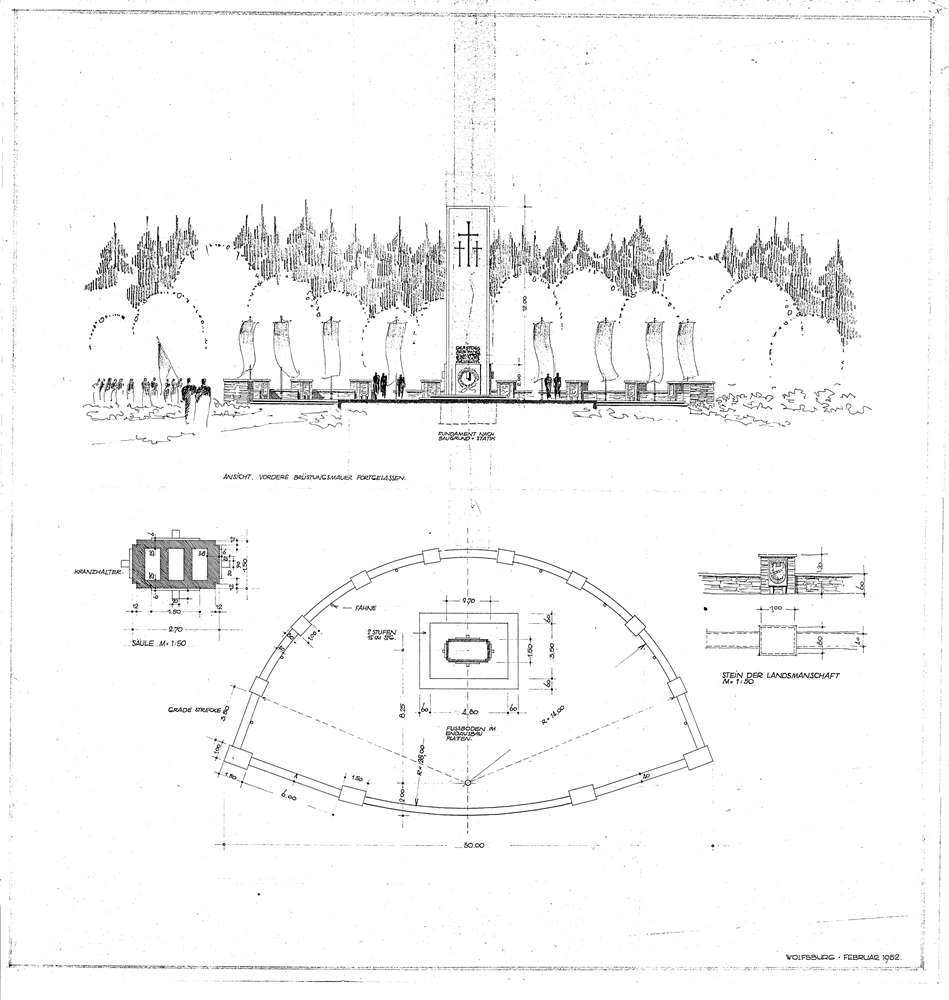
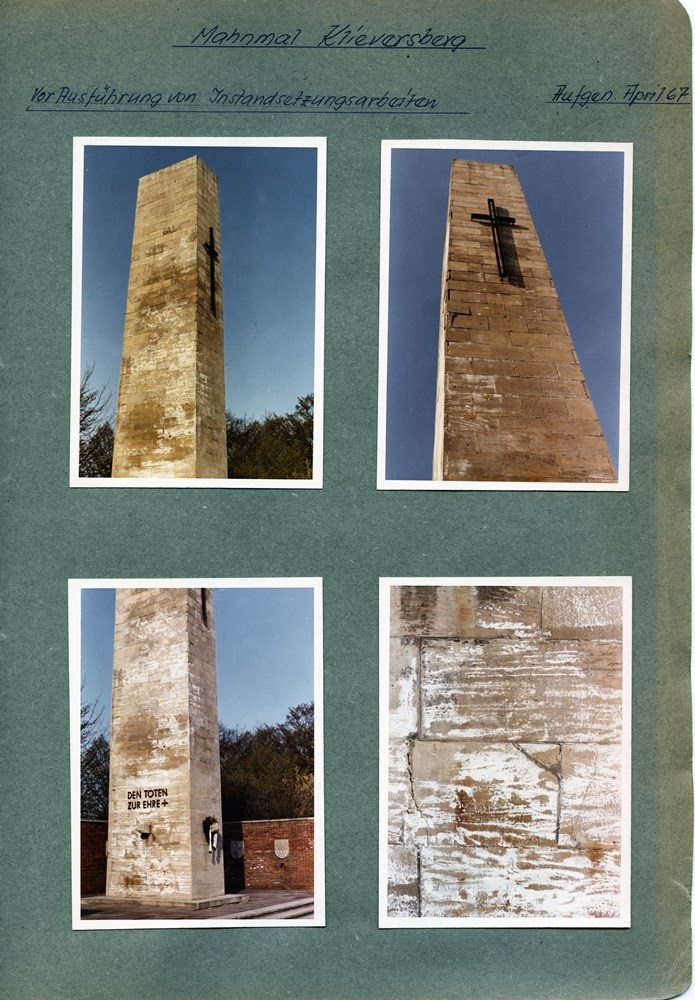
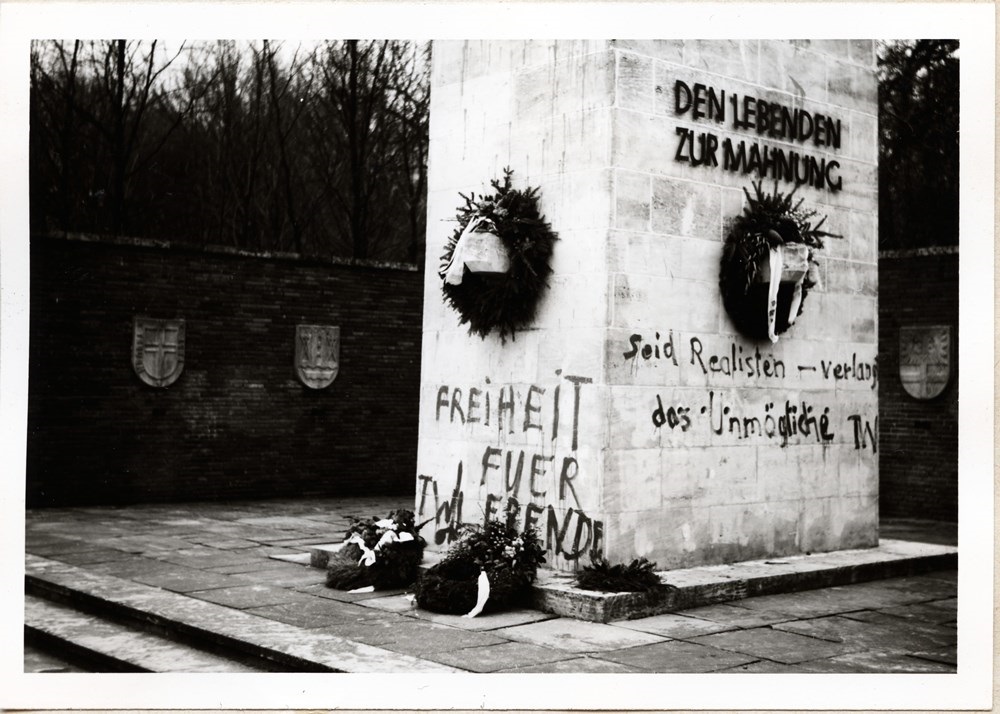
The displaced persons thus created a symbolic representation of their lost homeland—and did so at a prominent location within the urban landscape. At the same time, they used the memorial to commemorate their dead. Both of these intentions are made clear by the inscription on the monument, which is carved into the left and right sides of the facade of the 14-meter-high stele: “To the dead in honor” on the left, “To the living as a warning” on the right wing. It thus served simultaneously as a symbol of mourning and a call for the supposedly legitimate recovery of their lost homeland. This dual function is not uncommon for monuments to displaced persons. This is also why they are often found in cemeteries—as a substitute for burial sites that are no longer accessible or are entirely missing.[4] The Wolfsburg memorial, on the other hand, stands in the midst of nature high above the city—and yet can be regarded as a burial site in its own right: Inside the rectangular stele, which tapers slightly toward the top, a parchment scroll is embedded in the wall, listing the 305 names of all those family members who lost their lives during their flight.
The “Porsche View” on the Klieversberg: Once you’ve climbed the hill, the panorama stretches across the entire Wolfsburg city center and the Volkswagen plant located north of the Mittelland Canal. Even during the planning phase of the “City of the KdF Car near Fallersleben,” the focus was on developing the hillside: Commissioned to develop the city in the late 1930s, architect Peter Koller envisioned the construction of a monumental “crown of the city” on the Klieversberg. “Half Valhalla, half Reich Party Congress Hall”—that is how architect Dietrich Kautt described a planning sketch from 1938.[5] War-related resource shortages ultimately prevented its realization, so the site remained undeveloped for the time being.
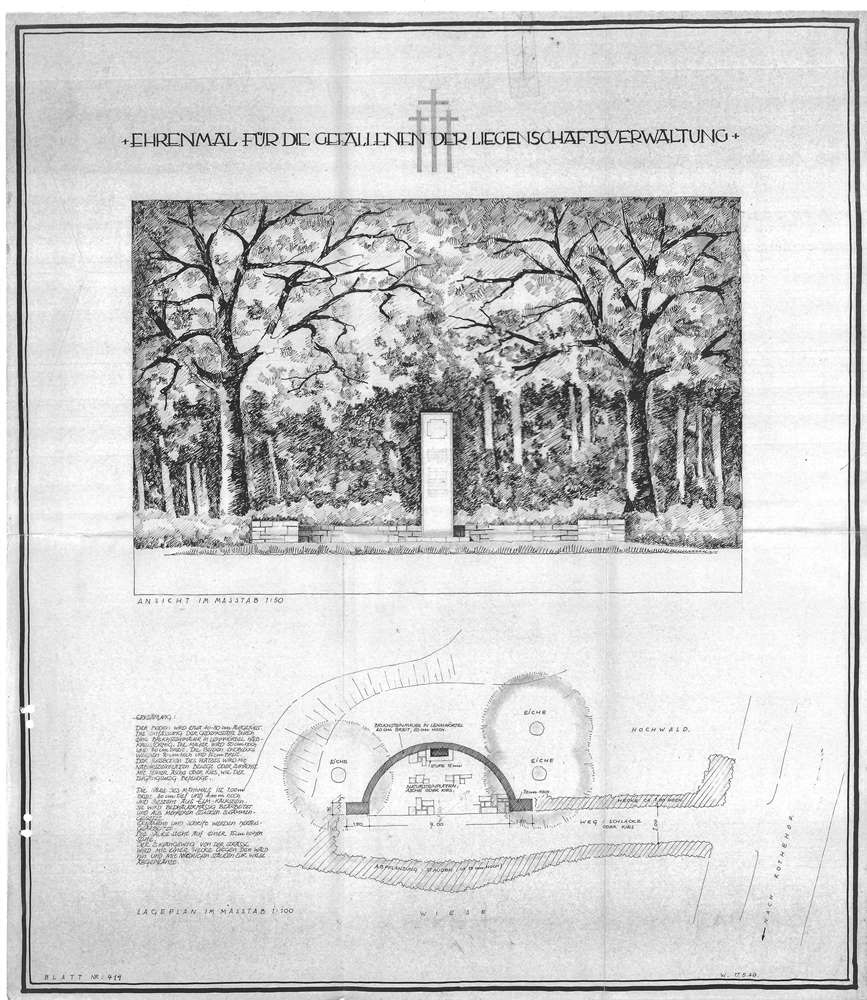
In the postwar period, it was the Federation of Displaced Germans (BvD) that pushed for the erection of a memorial at that very spot. The efforts of the association’s chairman, Georg Bednarek, in particular, gave new impetus to the idea in the spring of 1951.[6] His contacts with Dr. Wolfgang Muthesius—who was an honorary member of the newly established memorial commission and also served as property manager—apparently proved helpful in this regard. Financed with funds from the “Volkswagen Works Economic Association” as well as donations from the city’s residents, the cornerstone for the memorial was laid that same year according to the plans of architect Joachim Guhl and Walter Hultsch, head of the Parks and Gardens Department. – Although the memorial is not located in the city center, it was erected in one of Wolfsburg’s most prominent squares. Its visibility underscores the enormous significance the memorial held for the city’s residents in the early 1950s.[7] According to Stephan Scholz, who has authored a seminal study on memorials to displaced persons in West Germany, such a tranquil location was deliberately chosen to allow people to pause and reflect.[8]
“Temple or Obelisk on the Klieversberg?” read the headline in the Wolfsburger Tageblatt in early August 1951 on the occasion of the presentation of the first designs for the memorial.[9] In fact, the memorial commission at the time opted for a variation on the obelisk—a form that was actually no longer entirely in vogue by then—since the Wolfsburg memorial lacks the pyramid-shaped tip.[10] Obelisks were most widespread during the founding of the German Empire; and in the 1920s, they gradually fell out of fashion.[11] Nevertheless, the obelisk remains a common form in the German monument landscape, though it is more frequently found among war memorials. It is rather uncommon for the early 1950s.
Upon closer inspection of the memorial, the gaze is almost automatically drawn upward along the light-colored limestone cladding toward the sky—without encountering any clear symbols that evoke war, flight, or expulsion. Since the memorial was also intended to honor the victims of the bombing campaigns in other parts of Germany—[12] —the monument has a rather open character. This is also evident when compared to other memorials honoring displaced persons, such as the Eichendorffhain in Hildesheim, which faces east—toward the lost homeland.
However, the Wolfsburg stele was not to remain in its original form for long: For the red, 1.30-meter-high brick wall located behind the stele—which was framed by ten oak trees arranged in a semicircle—was to be adorned with the coats of arms of the individual regional associations in the early 1960s.[13] At this point, Peter Koller once again takes center stage in the events surrounding the Klieversberg. In his reinstated role as city planning director, he was responsible for the planned design of the memorial. After the BvD inquired in the fall of 1957 whether the memorial could be expanded accordingly, Koller took action—albeit not in the way he actually should have: Although, according to a decision made at the department heads’ meeting on November 22, 1957, he should have contacted the Wolfsburg-based firm Billen regarding this matter—[14] —Koller —expressing fundamental doubts about the firm’s design capabilities—to contact the sculptor Ulrich Kottenrodt. Kottenrodt was the son of Wilhelm Kotzde-Kottenrodt, with whom Koller was friends. They knew each other from their time together in the ethno-nationalist youth movement Adler und Falken. Like Koller, Kotzde and his son also had a National Socialist past. During the Nazi era, the latter created various ideologically charged sculptures and enjoyed high standing in leadership circles. In March 1958, this very same sculptor was commissioned by the city of Wolfsburg to design the coats of arms for the regional associations that were reclaiming their “German land in the East.”[15] After seeing several plaster test pieces [16], however, Koller was no longer so sure he had made the right choice. A handwritten note by Koller from September 1958 suggests his dissatisfaction with Kottenrodt’s work: “I explained to him why the execution is unsuitable and unappealing.”[17] A year and five unusable models later, the city’s chief architect weighed in and advocated for canceling the commission, which was indeed sent shortly thereafter by the municipal building authority to the Freiburg sculptor.[18]
After the final details regarding the design of the memorial were settled in a meeting between the BdV, representatives of individual regional associations, and the city administration, the Wolfsburg-based sculptor Peter Szaif was commissioned to create the coats of arms in late summer 1960.[19] In addition, the memorial was to be expanded to include a plaque, the text of which was determined by the first chairman of the BdV, Councilman Franz Graf von Ballestrem.[20] The coats of arms and the plaque were unveiled less than a year later, on June 17, 1961—which was then known as German Unity Day, a holiday observed until 1990 to commemorate the 1953 uprising of the East German population against Soviet rule.[21] A total of twelve coats of arms representing the regional associations of Wolfsburg residents now adorned the red brick wall behind the stele: the Baltic Germans, Memellanders, East and West Prussians, Danzigers, Warthelanders, Pomeranians, Brandenburgers, Silesians and Upper Silesians, Sudetenlanders, and finally the Transylvanians; six of them in the center and three each along the side borders.[22]
The coat of arms of the city of Wolfsburg was also affixed to the back of the stele: “You have found a second home in Wolfsburg, but do not forget your old homeland—your true home!” according to the interpretation by the *Wolfsburger Allgemeine Zeitung*. In fact, this addition seems paradoxical, since loyalty to one’s homeland and truly settling into a “second home” are diametrically opposed.
According to a study by historian Rainer Schulze, even in the mid-1990s, more than half of the displaced persons surveyed answered the question about their homeland by naming their place of birth.[23] According to this, a definitive break with the historical German East did not take place—not even in Wolfsburg. While the placement of the city coat of arms may be interpreted as a sign of gratitude, the memorial’s design completely lost sight of its second intention: to also commemorate the “victims of the bombing campaign.” In particular, the text panel, which ends with the words “Germans, Remain Loyal to Your Homeland,” draws attention to the displaced persons. Thus, the Wolfsburg memorial joins the ranks of those monuments that had a rather divisive effect and against which critical voices were already being raised as early as the 1950s.[24] It was not until March 1970 that the second intention was to be given architectural expression through a stylized grave slab embedded in the ground a few meters in front of the stele.[25]
Sources:
[1] Klaus J. Bade/Jochen Oltmer, “Introduction: Lower Saxony as a Destination for Immigrants. Immigration and Integration in Lower Saxony Since World War II,” in: Ibid. (eds.), Immigration and Integration in Lower Saxony Since World War II. Osnabrück 2002, pp. 11–36, here p. 13.
[2] “We, the Displaced Persons, Renounce Revenge…,” in: *Wolfsburger Allgemeine Zeitung*, November 20, 1953.
[3] Here and in the following, “Refugee Memorial on the Klieversberg Unveiled,” in: Wolfsburger Allgemeine Zeitung, November 23, 1953.
[4] Stephan Scholz, Memorials to Displaced Persons: Topography of a German Landscape of Memory. Paderborn 2015, p. 97.
[5] Dietrich Kautt, Wolfsburg in the Shift of Urban Planning Paradigms. Braunschweig 1989, p. 44.
[6] Here and in the following, “As a reminder to the living, in honor of the dead …,” in: Wolfsburger Allgemeine Zeitung, November 21–22, 1953.
[7] Scholz, Monuments to the Displaced (as in note 4), p. 26; Stephan Scholz, “Monuments,” in: Ibid./Maren Röger/Bill Niven (eds.), Remembering Flight and Expulsion: A Handbook of Media and Practices. Paderborn 2015, pp. 75–88, here p. 77.
[8] Scholz, Monuments to Displaced Persons (as in note 4), p. 68.
[9] “Temple or Obelisk on the Klieversberg?” In: Wolfsburger Tageblatt, August 4–5, 1951.
[10] StadtA Wob, HA 11976, vol. 2, excerpt from the minutes of the 13th meeting of the Cultural Committee on February 25, 1966; Ibid., Memorial on the Klieversberg; here: inquiry dated November 28, 1966. As can be seen from the plans for a possible redesign of the memorial, the monument was to be topped with a pyramid to give it the shape of an obelisk.
[11] Meinhold Lurz, War Memorials in Germany. Volume 4: Weimar Republic. Heidelberg 1985, p. 144.
[12] “As a reminder to the living, in honor of the dead…,” in: Wolfsburger Allgemeine Zeitung, November 21–22, 1953.
[13] StadtA Wob, HA 1751, Vol. 2, Joint proposal by the BvD and the VLD to the Wolfsburg City Council dated October 4, 1957; StadtA Wob, HA 11976, Vol. 2, Invoice No.: 68/80, Re: Memorial on the Klieversberg, dated November 14, 1980. The coats of arms were not supplemented with the names of the individual regional associations until 1980.
[14] StadtA Wob, HA 1751, Vol. 2, excerpt from the minutes of the department heads’ meeting of November 22, 1957.
[15] “We, the displaced persons, renounce revenge…,” in: *Wolfsburger Allgemeine Zeitung*, November 20, 1953.
[16] StadtA Wob, HA 1751, Vol. 2, Letter to Mr. Ulrich Kottenrodt, academic sculptor, regarding the coat of arms for the memorial to displaced persons in Wolfsburg, dated July 24, 1958.
[17] StadtA Wob, HA 1751, Vol. 2, I. Note concerns: Coat of arms for the memorial on Klieversberg, dated September 3, 1958.
[18] Wob City Archives, HA 1751, Vol. 2, 1) Note. Re: Memorial on the Klieversberg; here: installation of the coat of arms dated October 20, 1959; ibid., Building Administration Office to Ulrich Kottenrodt dated October 22, 1959.
[19] Wob City Archives, HA 1751, Vol. 2, Minutes of the meeting between representatives of the BdV from East German regional associations and representatives of the administration on February 3, 1960; ibid., excerpt from the 7th meeting of the Committee on Artistic Matters dated July 7, 1960.
[20] StadtA Wob, HA 1751, Vol. 2, excerpt from the minutes of the 10th meeting of the Committee on Art Matters, December 5, 1960.
[21] “June 17 in Wolfsburg,” in: Wolfsburger Allgemeine Zeitung, June 14, 1961; “13 Coats of Arms Adorn the Memorial,” in: Wolfsburger Allgemeine Zeitung, June 17–18, 1961.
[22] In the fall of 1986, the city of Wolfsburg granted the Association of Russian Germans permission to affix a coat of arms to the memorial. Since they had not lived in a specific region in Russia, they had never developed a corresponding coat of arms in the classical sense. In Wolfsburg, an ear of grain symbolizes their traditional connection to agriculture.
[23] Rainer Schulze, “‘We live here now.’ Refugees and Displaced Persons in Lower Saxony—Memory and Identity,” in: Bade/Oltmer, Immigration and Integration in Lower Saxony (as in note 1), pp. 69–100, here p. 84.
[24] Scholz, Monuments to Displaced Persons (as in note 4), p. 158.
[25] City of Wob, HA 11976, Vol. 2, excerpt from the minutes of the 52nd meeting of the Building Committee on March 12, 1970.
Published on November 7, 2018