
Employment office of the "city of the KdF car
In 1936, as a result of accelerated rearmament and intensified preparations for war, the German Reich achieved near-full employment, although there was a shortage of skilled workers and metalworkers, particularly in the construction industry. To avoid jeopardizing war preparations, the National Socialists made use of the Reich Agency for Employment and Unemployment Insurance, the local employment offices under its authority, and the higher-level state and Gau employment offices. Thus, in Nazi Germany, traditional bureaucratic institutions were primarily responsible for the allocation of labor and, later, of forced laborers—albeit under changed circumstances: While in the early 1930s the employment offices were still responsible for placing the unemployed and providing career counseling, after the Nazis came to power they evolved into an instrument of the state’s systematic direction of the labor force in accordance with overarching political requirements.[1]
For the construction of such a massive complex as the Volkswagen plant and the associated “City of the KdF Car near Fallersleben,” the procurement of labor was a central concern—and it would remain so until the end of the war. The newly established employment office was initially set up as a branch of the Helmstedt employment office and housed in the back room of a restaurant. Just a few weeks later, it moved to a barracks complex in the communal camp on Fallerslebener Straße, before being housed in a barracks on Schachtweg in 1940. And this was not to be the last move during the war years. It was first assigned an administrative barrack on the square in front of the Cianetti Hall. In 1944, it moved into two larger barracks on Clausewitzstraße—now Kleiststraße—where it remained housed even in the postwar period.[2] In the meantime, on February 15, 1942, the branch office was upgraded by decree of the responsible Reich Minister of Labor to an independent employment office, which was assigned the registration number 471.[3]
As a result of various decrees and ordinances issued between 1933 and 1939, the employment offices were granted extensive powers, enabling them to exercise virtually dictatorial control over the workers. One important innovation was the introduction of the work book in February 1935.

Employees could only be hired if they had a properly maintained work record book; the employment offices, in turn, could use this document to record the employee’s qualifications and work history and coordinate their assignments. Both white-collar and blue-collar workers were required to maintain such a work record book; it had to be kept on file with their respective employers.[4]
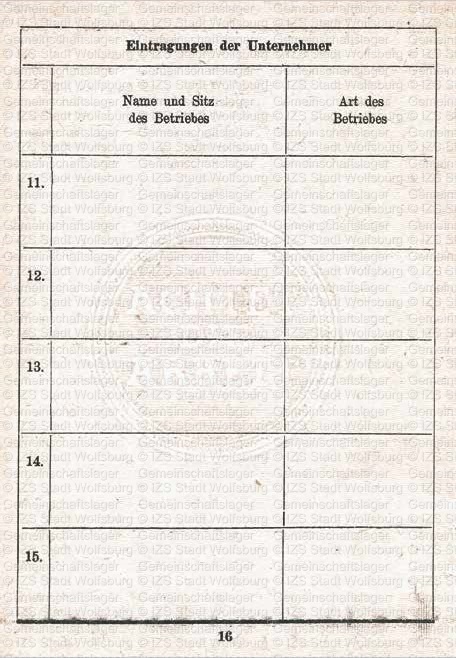
Their importance within the German war economy grew so significantly over the years that in 1942, Friedrich Syrup, State Secretary in the Reich Ministry of Labor, even compared them to military service cards, while referring to the employment offices as “civilian military district commands.”[5] The employment offices received another key authorization in February 1939. They were now permitted to compel workers to perform labor and to restrict job changes for reasons of state policy.[6] Under Fritz Sauckel, the Thuringian Gauleiter who was appointed General Plenipotentiary for Labor Deployment (GBA) in 1942, the labor administration underwent further changes. Employment relationships could now be terminated only with the consent of the responsible employment office. In addition, Sauckel was authorized to organize labor deployment and recruit forced laborers in the conquered and occupied territories.
As the president of the Lower Saxony State Employment Office informed the Gesellschaft zur Vorbereitung des deutschen Volkswagens m.b.H. in February 1939, the hiring of workers at the Volkswagen plant’s construction sites and in the city was to take place exclusively “through the mediation of the employment office.”[7] With the outbreak of war and the subsequent integration of the Volkswagen plant into the Nazi state’s war production, the company increasingly relied on the use of foreign forced laborers. A former employee of the Labor Office of the “City of the KdF Car” reported on this in the postwar period: “When there was a demand for foreign labor, our office reported this to the Gau Labor Office. [...] From there, we received notification of how many workers the ‘recruiters’ operating in the occupied eastern territories had registered, as well as when, where, and with how many people the transport could be picked up.”[8] The employment office in the Volkswagen city had hired a special “transport escort” to receive the Eastern European workers. The workers were first taken to temporary barracks; then they were led in groups to the employment office, where they were registered: “They presented their recruitment certificate with their personal information, or an interpreter questioned them. Some were unable to sign and instead made three crosses [...]. As a rule, it was Poles or Russians who arrived on the transport.”
[1] For more details, see Karsten Linne, “From Job Placement to ‘Work Assignment’: On the Transformation of Labor Administration, 1933–1945,” in: Marc Buggeln and Michael Wildt (eds.), Work under National Socialism. Munich 2014, pp. 53–70.
[2] “Ten Years of the Wolfsburg Employment Office. It Began Operations on February 28, 1942,” in: *Wolfsburger Nachrichten*, February 27, 1952.
[3] “Employment Office No. 471. Typical of the young city of Wolfsburg—Still in barracks today,” in: *Wolfsburger Nachrichten*, July 4, 1953. In March 1939, the National Socialists had declared the state employment offices to be Reich authorities subordinate to the Reich Minister of Labor. See Ordinance on Labor Deployment of March 25, 1939, in: RGBl. I, p. 575.
[4] For further details, see Stefanie Werner, Harald Degner, and Mark Adamo, “Hitler’s Transparent Workforce: The Work Book as a Source of Microdata for Historical Labor Market Research,” in: Yearbook for Economic History, Vol. 2 (2011), pp. 175–191.
[5] Linne, From Job Placement to “Labor Deployment” (as in note 1), p. 58.
[6] Ordinance on Ensuring the Labor Supply for Tasks of Particular Political Significance, dated February 13, 1939, in: RGBl. I, p. 206.
[7] Letter from the President of the Lower Saxony State Employment Office regarding labor deployment in Fallersleben to the Society for the Preparation of the German People’s Car, m.b.H., dated February 14, 1938, reprinted in Klaus-Jörg Siegfried, Wolfsburg City History in Documents. Origins and Development 1938–1945. Wolfsburg 1982, pp. 94–96.
[8] Here and in the following: StadtA WOB, S 20/41, notes by a former employee of the City Employment Office of the KdF-Wagen, undated.
[9] Hans Mommsen/Manfred Grieger, *The Volkswagen Plant and Its Workers in the Third Reich*. Düsseldorf 1996, p. 43.
[10] Manfred Grieger, “City of Wolfsburg,” in: Frank Ehrhardt (ed.), Topography of Memory. Memorial Sites for the Victims of National Socialism in the Braunschweig Region. Braunschweig 2004, pp. 159–189, here p. 165.