German Labor Front Barracks
The German Labour Front (DAF) was the organization with the largest membership in the "Third Reich". Its goal was explicitly stated in a decree issued by Hitler on October 24, 1934: It was to be used to realize "the formation of a real community of the people and of achievement for all Germans". It therefore had to "ensure that each individual can take his place in the economic life of the nation in the mental and physical condition that enables him to achieve the highest performance and thus guarantees the greatest benefit for the national community".1 The DAF, which was founded in May 1933 as the successor to the trade unions that had been smashed by the National Socialists, did not only represent the interests of the employees organized in it; it also included employers and the self-employed. The DAF's main task was to promote the integration of the workforce into National Socialism, which is why it exercised far-reaching support and control measures. Individual membership was nominally voluntary.2 However, it was difficult to resist the social pressure to become a member, as there was the threat of disadvantages in terms of finding a job or housing, social insurance or vacation planning. At the same time, DAF membership served many who did not want to join the NSDAP as a "useful and non-binding concession to the National Socialist regime, whose omnipresent demands for approval one did not dare to completely evade", as the historian Michael Schneider emphasizes.3
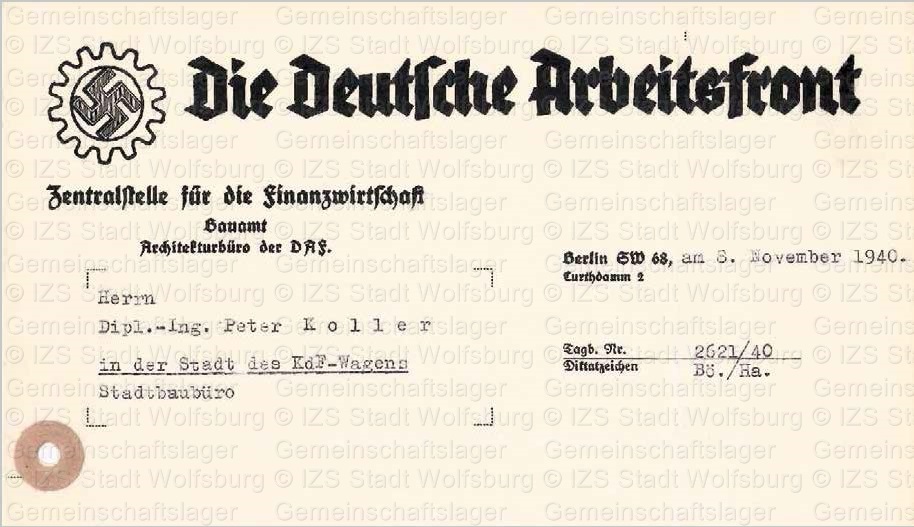
The DAF had enormous financial power from the annual contributions paid by its approximately 25 million members in 1942 alone. The monthly contributions were usually between 1.50 and 2.00 Reichsmark.4 In addition, the Nazi organization led by Robert Ley owned a huge business complex, which was primarily active in the banking sector, but also in automobile, shipbuilding, housing construction and publishing. At the height of the Second World War, the DAF employed around two hundred thousand people and generated an annual turnover of around two billion Reichsmarks.5 The DAF was also responsible for building the Volkswagen factory and the associated "City of the KdF Car near Fallersleben". Volkswagenwerk GmbH, as well as the urban planning office headed by Peter Koller and the Neuland housing association, were DAF companies, which therefore played a central role in the planned Nazi model city.
The DAF office in the "City of the KdF-Wagen" was housed in a barrack on Fallerslebener Straße in the communal camp. Despite the special importance of the Nazi organization in the factory and the city, its influence in the Volkswagen factory was limited. Its works chairman, Walter Krone, was responsible for the ideological orientation, supervision and control of the workers and repeatedly spoke at party rallies, but otherwise hardly made an appearance.6 However, the DAF held regular factory roll calls. However, the DAF had a say in the establishment of trade and commerce in the new town. In addition, in meetings with the city administration, it repeatedly complained about the low wages in particular, which were offset by the high rents, and thus stood up for its members.7
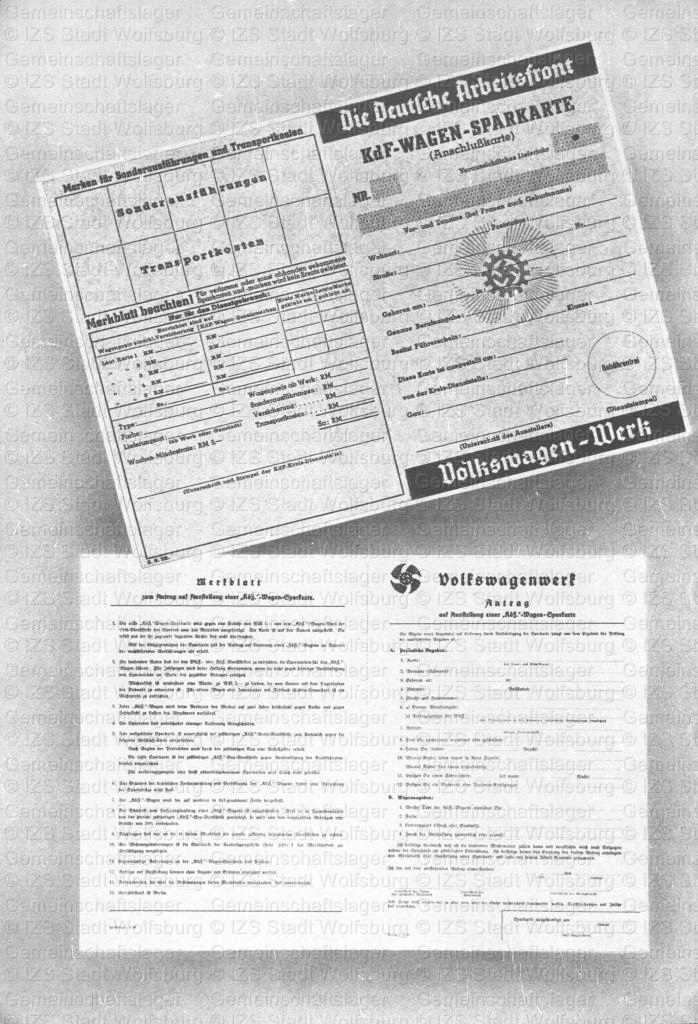
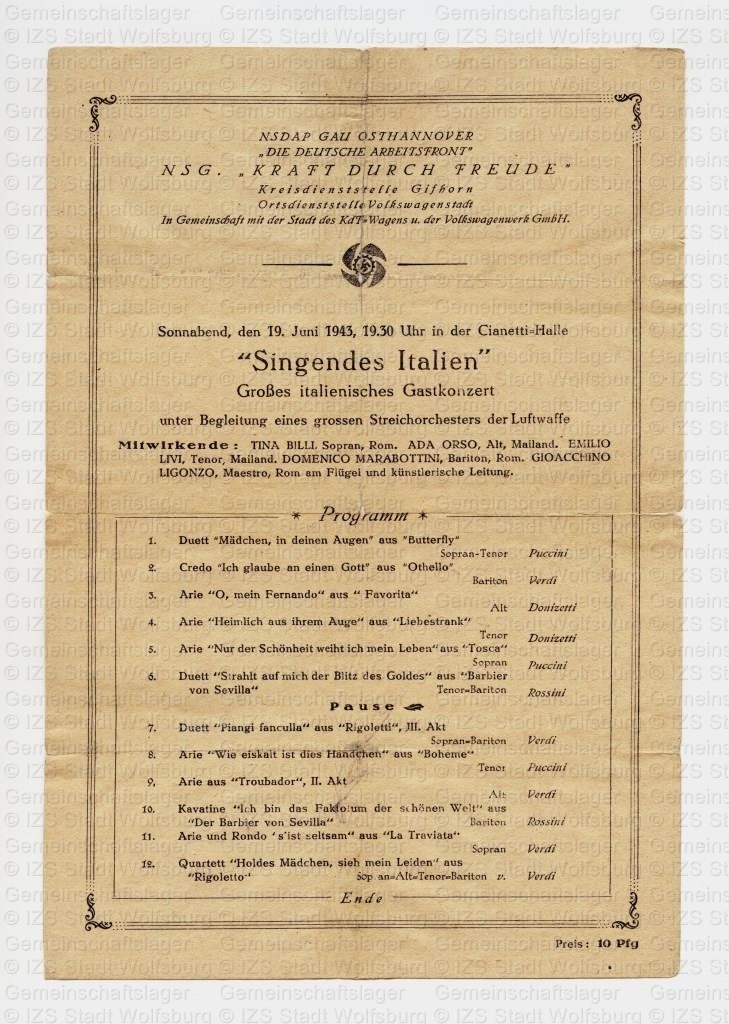
In addition to providing support for workers, the Nazi organization, through its subsidiary Kraft durch Freude (KdF), also played a significant role in social welfare and recreational activities for both workers and city residents. Under National Socialism, leisure was by no means an end in itself, but was intended to produce healthy and motivated workers. Thus, the KdF organization put together a broad recreational program that included not only concerts and dance evenings but also sports and variety shows, while the Office for Travel, Hiking, and Vacations arranged excursions and outings for the workers. However, the cruises abroad—promoted primarily by Nazi propaganda—as well as the promise of motorizing the “people’s community” through the Volkswagen, benefited only a very small number of “fellow citizens.” Essentially, the work of local KdF employees was limited to planning and carrying out art exhibitions, dance and social evenings, as well as organizing company sports clubs, readings, or bus trips to Lübeck, the Steinhuder Meer, Hamburg, or the Harz Mountains. Hikes along the Aller River were also part of the recreational offerings with which the Nazi organization sought to entertain the “fellow citizens.”8 It is not without reason that historian Rüdiger Hachtmann refers to the KdF organization as a “service provider for the Volksgemeinschaft.”9
[1] Regulation on the Nature and Aims of the German Labor Front of October 24, 1934, reprinted in: Otto Marrenbach, *Fundamente des Sieges. Die Gesamtarbeit der Deutschen Arbeitsfront von 1933 bis 1940*. Berlin 1940, pp. 17–19, here p. 17. See also Rüdiger Hachtmann, “Arbeit und Arbeitsfront: Ideologie und Praxis,” in: Michael Wildt/Marc Buggeln (eds.), Arbeit im Nationalsozialismus. Berlin 2014, pp. 87–106.
[2] The Reich Organizational Leader of the NSDAP (ed.), Organizational Handbook of the NSDAP, 3rd ed., Munich 1937, p. 225.
[3] Michael Schneider, *Under the Swastika: Workers and the Labor Movement, 1933–1939*, Bonn 1999, p. 178.
[4] Willy Müller, Social Life in the New Germany, with Special Reference to the German Labor Front, Berlin 1938, pp. 142ff.
[5] Rüdiger Hachtmann, The Economic Empire of the German Labor Front, 1933–1945. Göttingen 2012, p. 9.
[6] Hans Mommsen and Manfred Grieger, The Volkswagen Plant and Its Workers in the Third Reich. Düsseldorf 1996, p. 412. Hans Mommsen, “Experiences with the History of Volkswagenwerk GmbH in the Third Reich,” in: Lothar Gall/Manfred Pohl (eds.), Companies under National Socialism. Munich 1998, pp. 45–54.
[7] StadtA WOB, HA 259 I, Note regarding a meeting with the local chairman of the DAF, Bayer, on April 28, 1941.
[8] “Bus Trips Organized by the Nazi Organization ‘Kraft durch Freude’,” in: *Aller-Zeitung*, May 18, 1939.
[9] Rüdiger Hachtmann, “‘Service Providers for the People’s Community’? Notes on the Self-Conception and Function of the German Labor Front and the Nazi Organization ‘Kraft durch Freude’,” in: Detlef Schmiechen-Ackermann