
Prisoner of war/prison camp
The glaring shortage of skilled workers and other labor forced the Volkswagen plant to explore new avenues for recruiting workers early on, which is why, following the successful campaigns in Poland and France, those in charge increasingly relied on the use of prisoners of war beginning in 1940. They were housed primarily in the western section of the communal camp, between what is now Lessingstraße and Schachtweg. This section was separated from the rest of the camp grounds by a double barbed-wire fence and a 50-meter-wide strip and was under strict guard.[1]
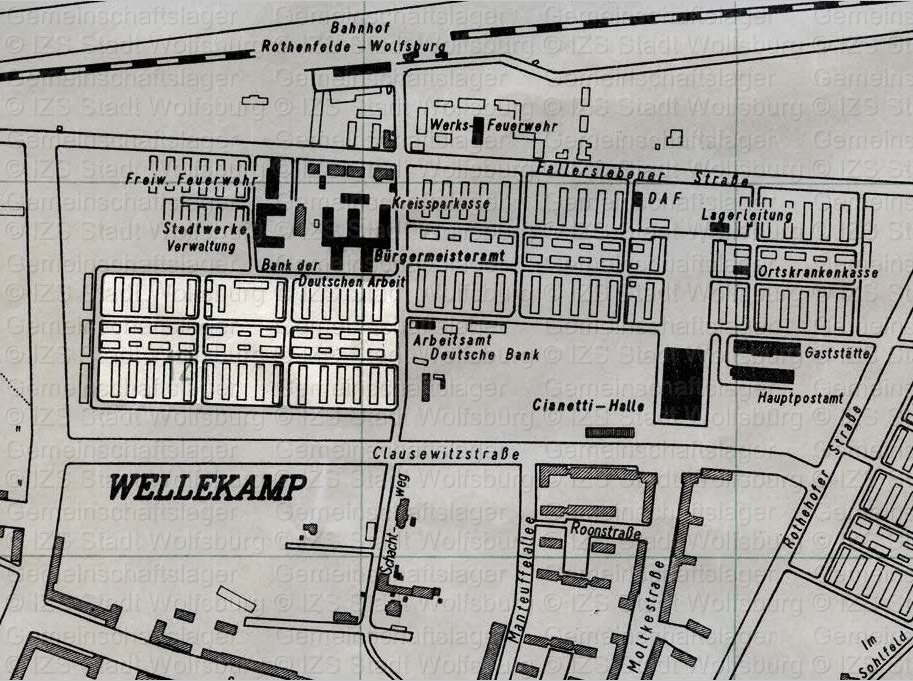
The capacity of the prisoner-of-war or penal camp was approximately 600 people; however, the complex was typically significantly overcrowded, housing 1,450 people. The inmates slept on three-tiered bunks, so that 24 prisoners were housed in a single room instead of the usual 16.[2] From 1940 to 1942, approximately 1,000 Wehrmacht penal prisoners—that is, convicted German soldiers—were held here. In addition, the French prisoner-of-war detachment was quartered in this camp from late 1940 until October 1942. Soviet prisoners of war followed at the end of 1941. After the fall of the Italian dictator Benito Mussolini, Italian prisoners of war—so-called “military internees”—who had been taken captive during the German Wehrmacht’s occupation of Italy were also held here.[3]
Even the presence of the Wehrmacht penal prisoners did not go unnoticed by the city’s residents: “The men were led in companies to the factory to work, and the severity of the offenses for which they were being punished was evident from their appearance. Some wore belts but no headgear; others wore neither belts nor headgear,” recalled Meinecke, an employee at the city’s main office, referring to the Wehrmacht penal prisoners.[4]
Among the foreign prisoners of war, the Soviet prisoners were subjected to particularly harsh and discriminatory treatment due to racist prejudices; abuse was commonplace. Their rations were completely inadequate, and they faced the harshest penalties for violations of factory and camp regulations. Contact with the outside world was prohibited; violations were met with the threat of being sent to the dreaded Penal Camp 21 near Salzgitter.[5] It was only with the arrival of the Italian military internees—who were denigrated as “Badoglio traitors”—that the treatment of Soviet prisoners changed: “Since the Italian prisoners of war have been here, Russian men and women have been treated much better. Now the Italians are being treated like animals,” reported the Dutch student Rinus Kop in 1944 in a letter home that was intercepted by the Foreign Mail Censorship Office.[6]
For the local population, the various groups of prisoners of war were easy to distinguish based on their markings. For example, Soviet prisoners were marked with an “SU” on their outer clothing. The prisoners were also deployed not only in the factory but also in businesses within the city, in the surrounding area, and on farms. Despite the Nazi state’s racist propaganda, isolated instances of unwanted contact occurred between Soviet prisoners of war and the local population, which is why local officials often felt compelled to intervene: “Although violations in this regard declined primarily thanks to the Party’s educational efforts, there are still occasional instances that call for decisive intervention, especially when women who have lost all sense of honor, devoid of any national pride, trample on German honor,” explained Senior Government Councilor Dr. Krause in June 1942.[7]
[1] StadtA WOB, EB 2, Interview with City Administrator Meinecke on May 14, 1970, p. 12.
[2] Hans Mommsen/Manfred Grieger, The Volkswagen Plant and Its Workers in the Third Reich. Düsseldorf 1996, p. 564.
[3] Ibid., p. 743.
[4] WOB City Archives, EB 2, Interview with City Administrator Meinecke on May 14, 1970, p. 12.
[5] Mommsen/Grieger, The Volkswagen Plant and Its Workers in the Third Reich (as in note 2), pp. 551–565.
[6] BArch R58/9794, letter from the Cologne-Riehl Foreign Mail Screening Office dated February 11, 1944.
[7] “The New Municipal Police. Farewell to the Gendarmerie, Which Has Been Replaced by the Municipal Police,” in: *Die Neue Zeit*, June 19, 1942.