
Barrack of the camp management
On March 19, 1938, the *Aller-Zeitung* reported on the completion of the first barracks at the communal camp, which was intended to house the workers needed to build the factory and the city. The Tageblatt seemed to have already anticipated at the time that this temporary barracks complex would become a central district—and would not simply make way for new buildings as the city’s development progressed—as it noted: “Once the work is completed, the barracks area will form a district in its own right.”[1]
Responsible for this small “wooden town” [2] was the camp administration, which was housed in a barracks north of the roll call square in front of the Cianetti Hall.

It primarily carried out administrative tasks. For example, it was responsible for organizing meals for the camp residents, while also organizing sporting events and movie nights.[3] However, the camp administration also exercised a supervisory and controlling function through its officials. These camp leaders and officials were employees of the Volkswagen plant and were selected by its personnel director. They were merely confirmed by the German Labor Front (DAF)—according to whose guidelines the communal camp was run.[4] The camp was expanded several times between 1938 and 1945. While it held between four and five thousand people in October 1938, its capacity had already reached approximately 10,000 by 1941. However, the number of inmates fluctuated constantly; it eventually stabilized at between 8,000 and 9,000 people.[5]
The barracks of the communal camp had been constructed in accordance with the regulations of the Reich Labor Service and were grouped around the rectangular roll call area in front of the Cianetti Hall.
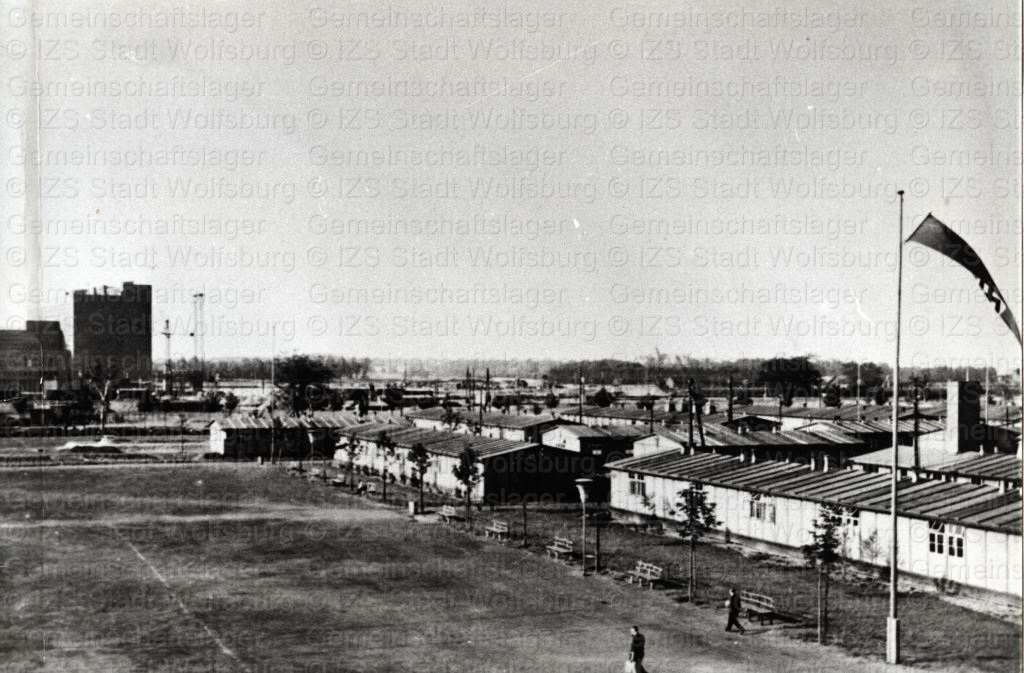
Here, as everywhere else in the Reich, the layout of the space and its division into segments were intended to enable the camp administration to exercise comprehensive control and discipline over the camp inmates.[6] The rigid layout of the barracks was intended to make it difficult for inmates to wander about unobserved. There were no provisions for individual retreats or nooks, making any form of independent initiative virtually impossible. This was precisely the intention and was meant to contribute to the de-individualization of the inmates as well as to the formation of the “people’s community.” The barracks’ barracks-like layout, as well as the strict demarcation by fences and gates, also gave the camps a military character. In practice, however, the Nazis failed to achieve this goal, as evidenced by the particularly high number of thefts and alcohol-related offenses in the camp.[7]

The communal camp was also divided into different sections, each comprising five to seven individual camps and under the command of a camp commander. Each individual camp consisted of nine barracks and included barracks for the inmates, washrooms, and kitchens, as well as an administrative barrack and a commandant’s barrack. The latter were situated at right angles to the other barracks and were slightly smaller than they were.[8] Camps 1 through 7 were located between Schachtweg and the Cianetti Hall and had already been built in 1938. Camps 8 through 15 were located east of what is now Porschestraße; in 1942, they were converted into the “Ostlager” and separated from the rest of the grounds by high barbed-wire fences. Camps 16 through 21, in turn, were situated between Schachtweg and what is now Lessingstraße. Starting in 1943, so-called military internees and prisoners of war were housed here.[9]
The camp commander’s primary responsibility was “managing people” and “caring for people.”[10] In addition to his administrative duties, he was expected to shape the character of the camp inhabitants in accordance with the National Socialist educational mandate. In keeping with the “model city” propaganda, the *Aller-Zeitung* saw this task realized in an outstanding manner at the communal camp in the “City of the KdF Car,” which is why it already stood as an exemplary leader among all camps in the Reich: “The most important thing, however, is the spirit that prevails in the camp—a spirit that is awakened and fostered by the camp commander, through the barracks elders, among all the residents of the barracks. It takes a great deal of idealism and the right tone to make this a communal camp—one that can now be regarded as a model camp for all of Germany.”[11]
[1] “A Barracks Town in the Making—News on the Construction Work for the Volkswagen Factory,” in: Aller-Zeitung, March 19, 1938.
[2] This was the contemporary name for the town; see, for example: “A Letter from Room 24—Carpenters from Burgenland Write from the Town of the KdF Car,” in: Aller-Zeitung, July 23, 1938.
[3] “Sports at the Volkswagen Plant Community Camp,” in: Aller-Zeitung, August 23, 1938; “An Easter Walk: Around the Volkswagen Plant,” in: Aller-Zeitung, April 8, 1939.
[4] Klaus-Jörg Siegfried, The Life of Forced Laborers at the Volkswagen Plant. Frankfurt am Main/New York 1988, p. 94.
[5] Hans Mommsen/Manfred Grieger, The Volkswagen Plant and Its Workers in the Third Reich. Düsseldorf 1996, p. 743.
[6] Here and in the following, Kiran Klaus Patel, “‘Selection’ and ‘Extermination’: The Janus Face of the Nazi Camps,” in: Zeitschrift für Geschichtswissenschaft, Vol. 54 (2006), No. 4, pp. 339–365, here pp. 346–348.
[7] A review of the 1938–1945 issues of the *Aller-Zeitung* revealed that numerous thefts and other offenses occurred in the camp and on city grounds.
[8] StadtA WOB, EB 5, interview with Walther Strohfeldt on September 27, 1968.
[9] Mommsen/Grieger, *The Volkswagen Plant and Its Workers in the Third Reich* (as in note 5), pp. 742ff., as well as Siegfried, The Life of Forced Laborers at the Volkswagen Plant (as in note 4), p. 95.
[10] Cf. Otto Marrenbach, Foundations of Victory. The Overall Work of the German Labor Front from 1933 to 1940. Berlin 1940, p. 180.
[11] “The Volkswagen Plant Grows from Iron and Concrete,” in: Aller-Zeitung, October 22, 1938.