
The Post Office of the "City of the KdF Car
It wasn't until the 1970s that the telephone became a standard fixture in West German households.[1] Prior to that, for centuries, letter mail had served as the only means of long-distance communication; accordingly, municipal post offices played a major role during that time. In the newly founded “City of the KdF Car near Fallersleben,” the post office played a particularly significant role. This was because the population of the newly founded city was composed of people from many parts of Germany. For the new residents, letter-writing was usually the only way to stay in touch with family back home. After the first Italian workers arrived in the town in September 1938 and, as the war progressed, an increasing number of foreign forced laborers were deployed in the town and at the factory, the postal service began to gain even greater importance as a means of communication.
On July 18, 1938, the city—which was just over two weeks old at the time—received its own post office.
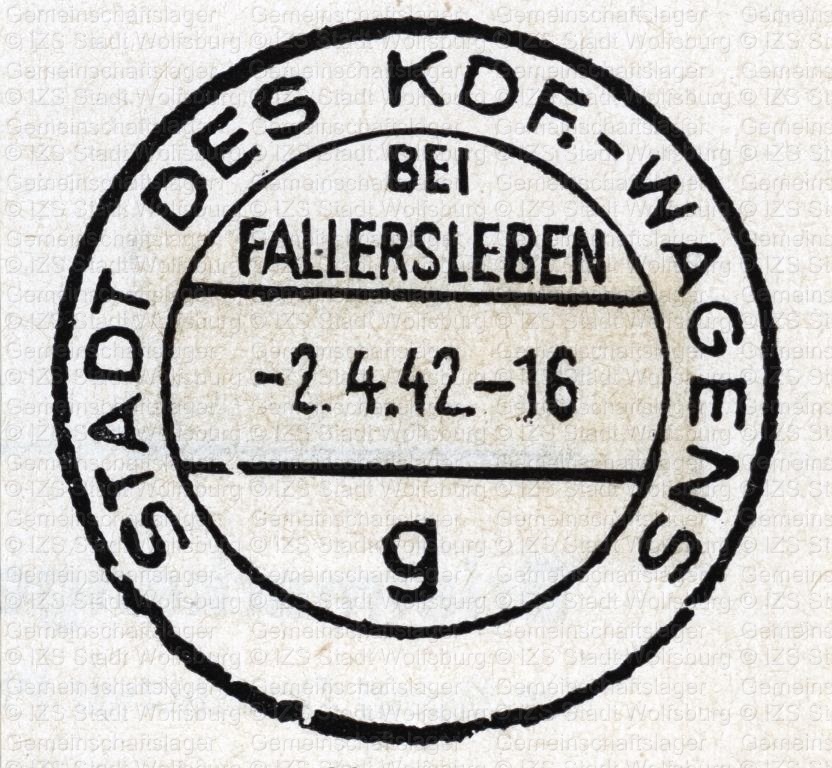
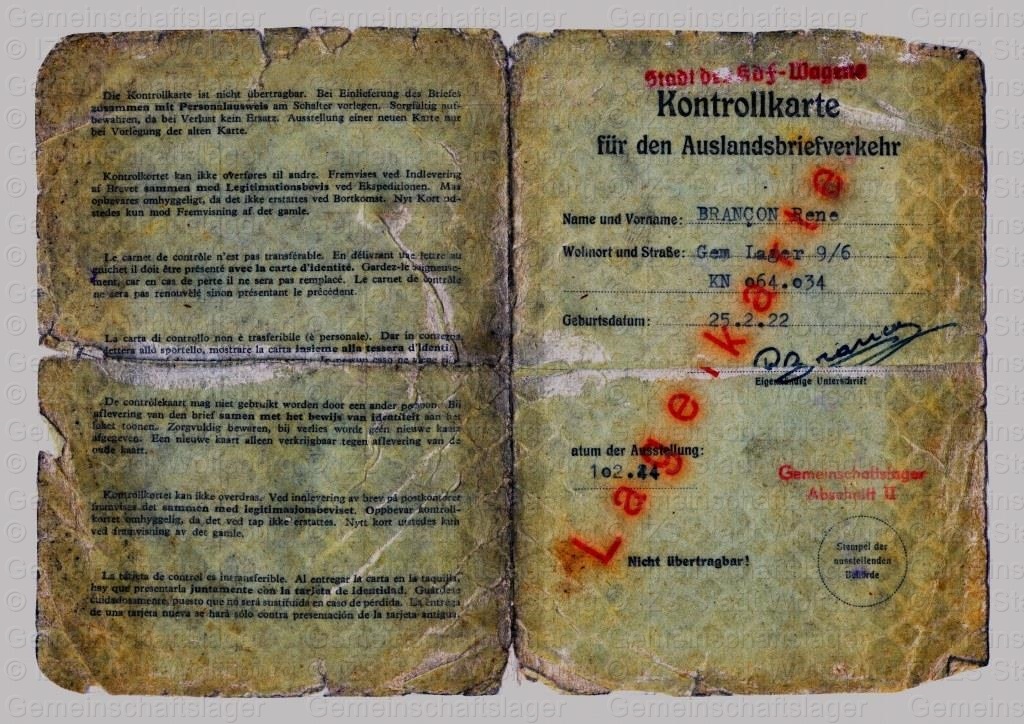
Previously, mail had been handled by a branch of the Vorsfelde Post Office located in Heßlingen. The new post office had six counters and was located in a barrack on the roll call square of the communal camp. According to the *Aller-Zeitung*, it differed from the other barracks—which would shape the city’s appearance well into the postwar period—only by the “Deutsche Reichspost” sign, the mailbox, the stamp and postage meter, and the postal van.[2] By November 1938, the volume of mail had already reached about 2,000 items per day—even though the town had a population of just around 5,500 at the time, of whom about 2,500 were Italian. By that same time, the post office had already processed more than 25,000 international mail items. According to press reports, postal workers had even learned Italian for this reason. Delivery within the camp itself was made directly to the recipients, twice in the morning and once in the evening. Parcels, however, had to be picked up directly at the post office, which had its own customs clearance office. In addition, there were separate envelopes for German and Italian workers. Even the forced laborers who had been deported to the settlement on the Mittelland Canal during the war were permitted to correspond with their families back home, as long as postal connections to the occupied territories remained in place. However, the letters were subject to censorship.
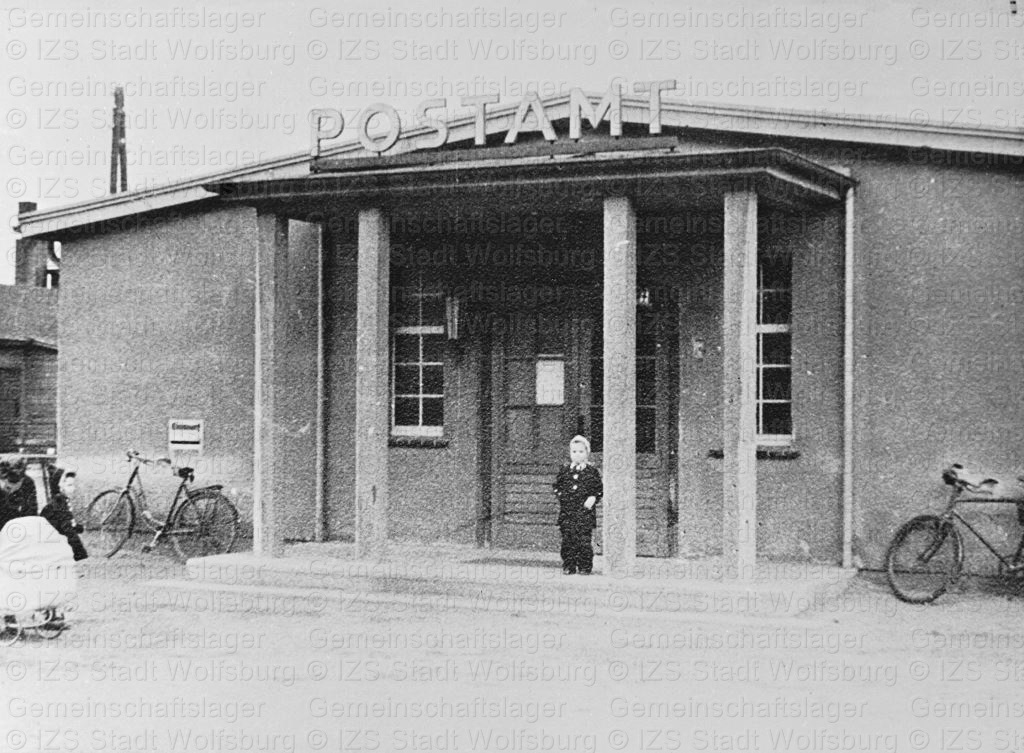
On July 10, 1939, the post office moved into a solid stone building right next to the Cianetti Hall. The move was due to the steadily increasing volume of mail. “The long, bright, and colorfully painted building sits nicely and invitingly next to the huge hall,” noted the Aller-Zeitung.[3]
The city’s steady growth led to the opening of the post office’s first branch in the Steimker Berg neighborhood, effective September 3, 1940. In addition, new mailboxes were installed throughout the city, and more staff were hired.[6] In light of the wartime labor shortage, the post office hired four women as mail carriers for the first time in March 1943 and assigned them to delivery and station duties.[7]Although construction of the “City of the KdF Car”—planned as a Nazi model city—was progressing, the post office was once again housed in a temporary building.
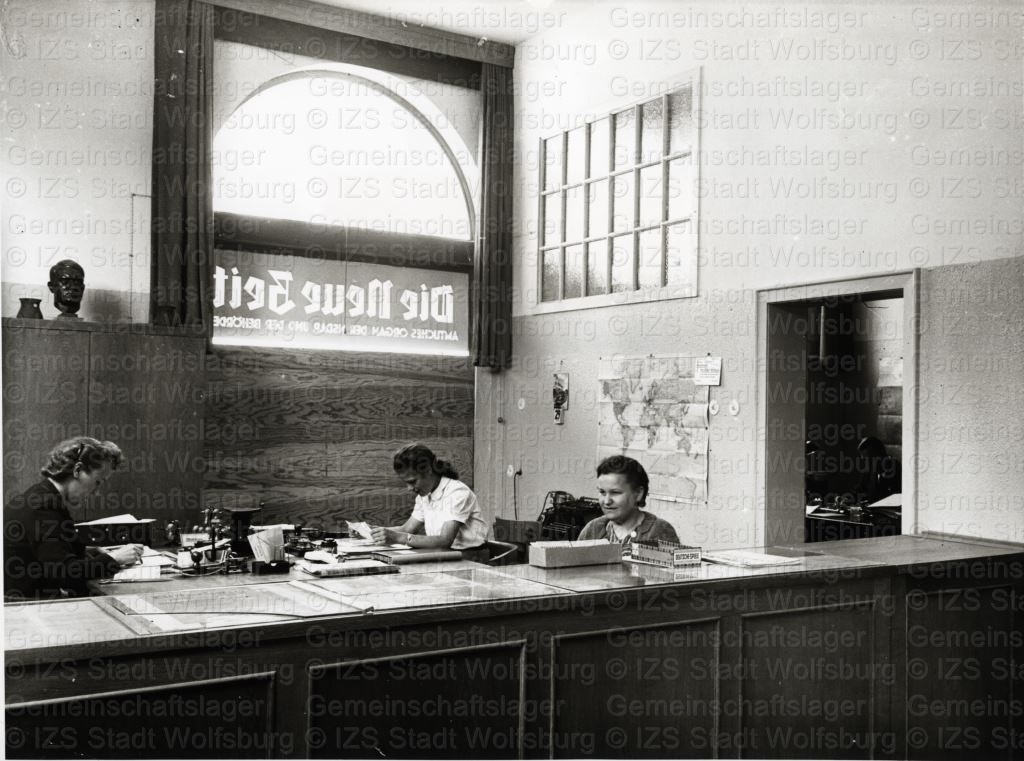
The press at the time was aware of this issue, so it sought to gloss over the problem by presenting the building—and especially its interior—in a favorable light. For example, the newspaper praised the new “large counter area,” which allowed for “smooth and quick service.” As early as November of that same year, two telephone booths were installed in the post office.[4] The culmination of these curious accolades came in November 1940, when, in light of the installation of steam heating, the Aller-Zeitung wrote that the post office of the Nazi “model city” would now develop into a “model post office.” From 1939 to 1941, the editorial office of *Die Neue Zeit*, the official party newspaper of the “City of the KdF Car,” was also located on the post office premises.[5]
[1] Werner Rammert, “The Telephone and Communication Culture: Acceptance and Diffusion of a Technology in a Four-Country Comparison,” in: Kölner Zeitschrift für Soziologie und Sozialpsychologie, Vol. 42 (1990), pp. 20–40.
[2] “The Postal Service in the City of the KdF Car,” in: Aller Zeitung, November 4, 1938.
[3] “The New Post Office Opens,” in: Aller-Zeitung, July 12, 1939.
[4] “The Post Office Serves Its Customers,” in: *Aller-Zeitung*, November 19, 1939.
[5] StadtA WOB, S 40/8, undated newspaper article “Five Years of ‘Die Neue Zeit’,” in: Die Neue Zeit, July 1944.
[6] “The First Branch Post Office Established,” in: Aller-Zeitung, September 5, 1940.
[7] “The First Female Mail Carriers,” in: Aller-Zeitung, March 15, 1943.