
Municipal heat planning
Pending Translation:
Die Kommunale Wärmeplanung (KWP) bildet ein zentrales Instrument, um die ambitionierten Klimaschutzziele Deutschlands im Gebäudesektor zu erreichen. Ihr hoher Stellenwert ergibt sich insbesondere aus dem erheblichen Anteil, den Raumwärme und Warmwasser an den lokalen CO2-Emissionen haben. Eine systematische Planung ermöglicht zielgerichtet fossile Energieträger schrittweise zu ersetzen und eine nachhaltige, effiziente und klimaneutrale Wärmeversorgung vor Ort aufzubauen.
Die Stadt Wolfsburg trägt mit der Erstellung einer kommunalen Wärmeplanung maßgeblich zur Dekabonisierung des Wärmemarktes bei. Im Dezember 2024 startete die Stadt Wolfsburg das Projekt in enger Zusammenarbeit mit den lokalen Stakeholdern.
Pending Translation:
Nach dem Niedersächsischen Klimaschutz Gesetz (Paragraph 20, NKlimaG) sind Kommunen ab einer Größe von 10.000 Einwohner verpflichtet eine kommunale Wärmeplanung durchzuführen. Die Konzepterstellung hat für Städte mit min. 100.000 Einwohner bis Ende Juni 2026 zu erfolgen.
Pending Translation: Erarbeitung der kommunalen Wärmeplanung KWP (Stand Juni 2026)
-
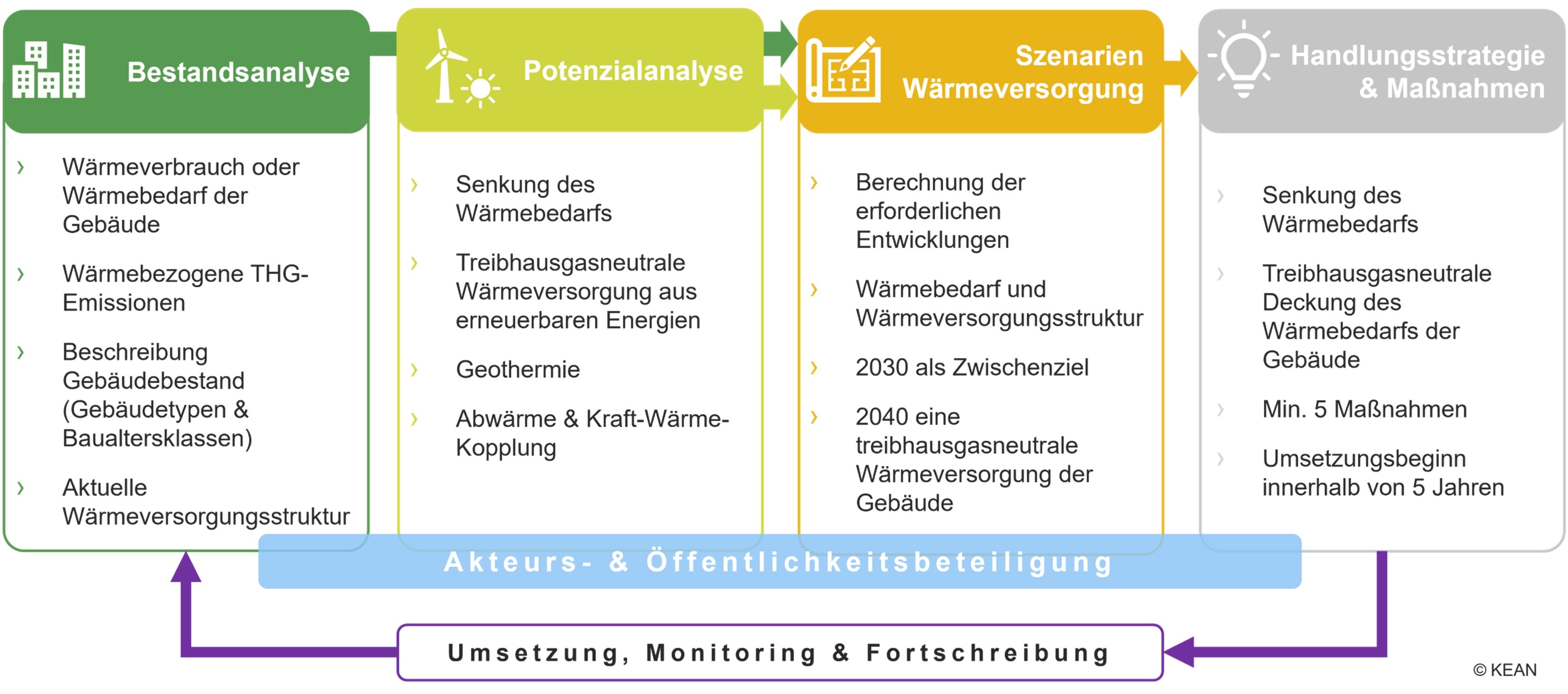
Explanation of the diagram
The diagram describes the four building blocks of municipal heat planning.
It shows from left to right:
1. inventory analysis
- Heat consumption or heat demand of the buildings
- Heat-related greenhouse gas emissions (GHG)
- Description of existing buildings (building types & building age classes)
- Current heat supply structure
Here you will find the results of the inventory analysis
2. potential analysis
- Reduction of the heat demand
- Greenhouse gas-neutral heat supply from renewable energies
- Geothermal energy
- Waste heat and combined heat and power generation
3. heat supply scenarios
- Calculation of the necessary developments
- Heat demand and heat supply structure
- 2030 as an interim target
- 2040 a greenhouse gas-neutral heat supply
4. action strategy and measures
- Reduction of the heat demand
- Greenhouse gas-neutral coverage of the heat demand of buildings
- At least 5 measures
- Start of implementation within 5 years
These four building blocks form the stakeholder and public participation.
The fourth building block "Action strategies and measures" results in implementation, monitoring and updating, which is again based on the first building block.
Municipal heat planning consists of four main components:
1. Bestandsanalyse
- Wärmeverbrauch oder Wärmebedarf der Gebäude
- Wärmebezogene Treibhausgasemissionen (THG)
- Beschreibung Gebäudebestand (Gebäudetypen und Baualtersklassen)
- Aktuelle Wärmeversorgungsstruktur
- Erarbeitung eines Gebäudekatasters für Wolfsburg - nähere Informationen finden sie hier
Hier finden Sie die Ergebnisse der Bestandsanalyse (Seite 2)
2. Potentialanalyse
- Senkung des Wärmebedarfs
- Treibhausgasneutrale Wärmeversorgung aus Erneuerbarer Energie
- Geothermie
- Abwärme und Kraft-Wärmekopplung
Hier finden Sie die Ergebnisse der Potentialanalyse (Seite 3)
3. Szenarien Wärmeversorgung
- Berechnung der erforderlichen Entwicklung
- Wärmebedarf und Wärmeversorgungsstruktur
- 2030 als Zwischenziel
- 2040 eine Treibhausgasneutrale Wärmeversorgung
Hier finden Sie die Ergebnisse der Zielszenarien zur Wärmeversorgung (Seite 3 - 4)
4. Handlungsstrategie und Maßnahmen
- Senkung des Wärmebedarfs
- Treibhausgasneutrale Deckung des Wärmebedarfs der Gebäude
- Mindestens 5 Maßnahmen
- Umsetzungsbeginn innerhalb von 5 Jahren
Diese vier Bausteine bilden die Akteurs- und Öffentlichkeitsbeteiligung.
Aus dem vierten Baustein "Handlungsstrategien und Maßnahmen" ergibt sich die Umsetzung, das Monitoring und die Fortschreibung, die wieder am ersten Baustein ansetzt.
Hier finden Sie die Maßnahmen zur Wärmewende (ab Seite 11)
Ratsbeschluss zum Endbericht
Der Rat der Stadt Wolfsburg hat am 17.06.2026 das Konzept zur kommunalen Wärmeplanung in Form eines Endberichtes mit allen Analysen, Kartendarstellungen und Maßnahmen beschlossen. Den Endbericht finden Sie hier.
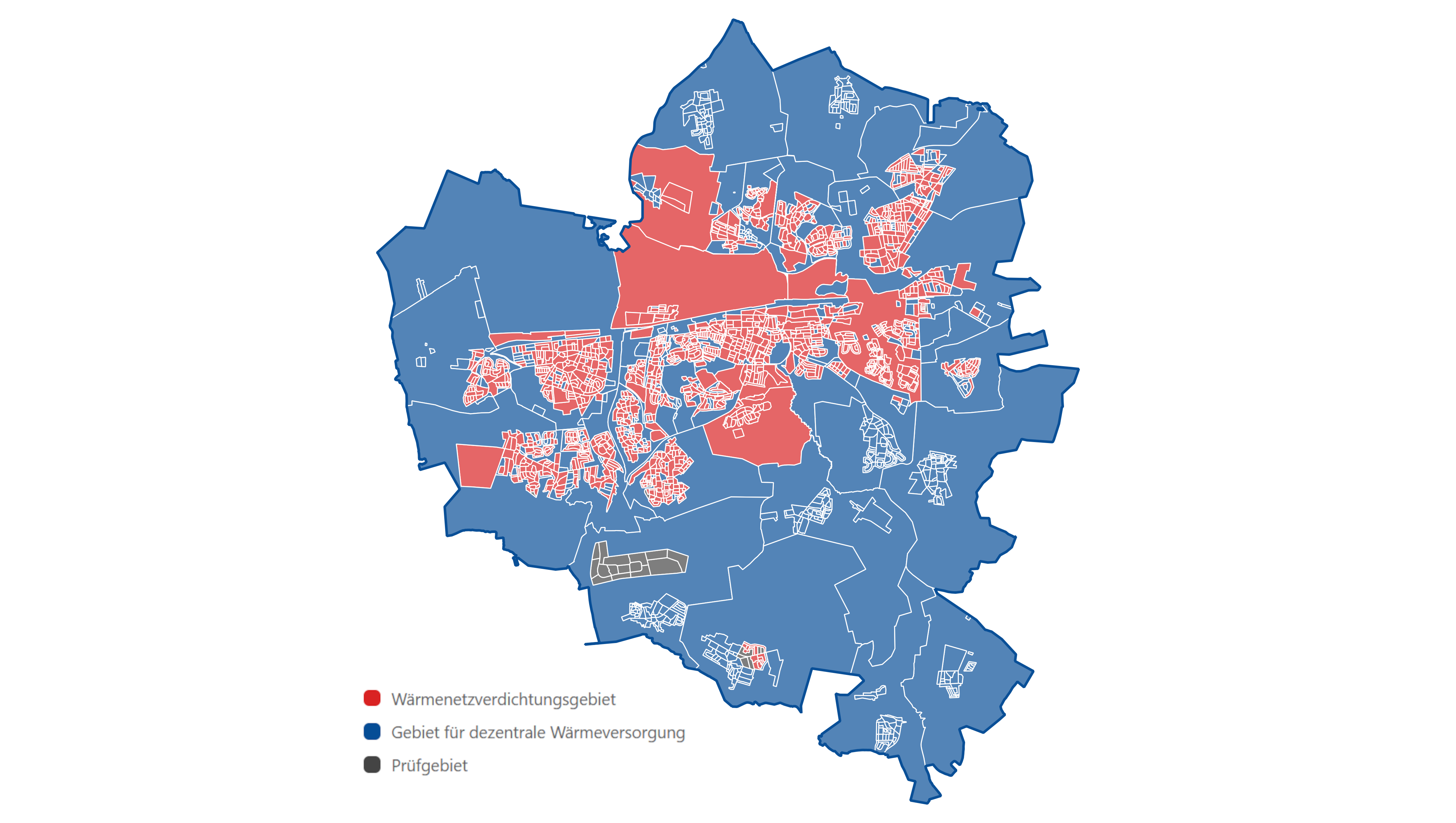
Interaktive Wärmekarte
Hier bekommen Sie Informationen über die Wärmeversorgung in der Stadt Wolfsburg
Wie geht es weiter?
Die kommunale Wärmeplanung beinhaltet sechs Umsetzungsmaßnahmen für die Wärmewende in Wolfsburg. Weitere Informationen zu den Maßnahmen und ihrer Umsetzung finden Sie hier (ab Seite 11).
Förderung von Energieberatungen (Initialberatung)
Rund um die Themen Heizung, Nutzung erneuerbarer Energien oder der Gebäudehülle können Sie sich beraten lassen. Die Energieberatung (Initialberatung) wird durch die Verbraucherzentrale Niedersachsen in Kooperation mit der Wolfsburger Energieagentur durchgeführt und durch die Stadt Wolfsburg gefördert. Informationen zur Energieberatung und zur Anmeldung finden Sie hier.
Pending Translation: FAQ | Fragen zur Kommunalen Wärmeplanung
-
What is municipal heat planning?
Municipal heating planning plays a key role in ensuring that Germany becomes climate-neutral by 2045. This is because heat supply, i.e. heating and hot water, accounts for more than 50 percent of total final energy consumption and is responsible for a large proportion of CO2 emissions in Germany.
The aim of municipal heat planning is to determine and design the most sustainable and cost-efficient heat supply at local level. By enabling a strategic orientation and planning of the heat supply, it supports municipalities in achieving long-term energy and climate targets and implementing the energy transition locally - with the help of waste heat, renewable energies and also hydrogen. Municipal heat planning is an informal planning instrument. It is to be understood as an overarching municipal strategy that does not trigger any direct obligations with regard to energy and heat sources for companies or private households.
-
Why is the city of Wolfsburg drawing up a municipal heating plan?
With the amendment of the Lower Saxony Climate Act (NKlimaG) on 05.07.2022, the creation of a municipal heating plan is mandatory for Wolfsburg from 01.01.2024. A corresponding legal framework has also been created at federal level with the Heat Planning Act (WPG). For municipalities in Lower Saxony, however, only the NKlimaG is applicable. In Wolfsburg, municipal heat planning was also adopted as a measure by the Committee for the Environment, Climate Protection and Sustainability as early as 2022.
-
What does municipal heat planning involve?
Municipal heat planning essentially consists of
- an analysis of the energy infrastructure and building stock
- a survey of consumption in residential buildings and industrial processes with waste heat generation
- an investigation of the potential of local renewable energies
- the development of a target scenario ("heat plan") to describe a greenhouse gas-neutral supply structure
- a "heat transition strategy" as an interface between the preparation of the heat plan and its actual implementation.
In this way, municipal heat planning links the demand for heat with the availability of renewable energies.
The necessary (data protection) legal requirements for the collection of data have been created by Section 21 NKlimaG.
-
What is the purpose of municipal heat planning?
Municipal heat planning provides orientation as to which type of heat supply should be prioritized in which parts of the urban area and thus represents an essential basis for supply and urban planning. This also has a particular impact on the framework conditions of energy concepts for new development areas and urban renewal measures in existing buildings.
-
What is the legal basis for processing data for municipal heat planning?
The city of Wolfsburg is currently preparing the mandatory heat plan. The data controller for the data to be collected as part of the inventory analysis of municipal heat planning in accordance with Section 21 NKlimaG is the Statistics and Urban Research Department (statistics office) in the Data, Strategies, Urban Development Department. It is technically, organizationally and in terms of personnel separate from other organizational units of the administration in accordance with the statutes governing the statistics office of the City of Wolfsburg and its separation in conjunction with Section 9 of the Lower Saxony Statistics Act. The statistics office regularly processes personal data on a large scale for statistical purposes and has appropriate technical and organizational measures in place.
In accordance with Section 21, the City of Wolfsburg collects personal data on the energy consumption of buildings from LSW and information on heat generation systems from the responsible district chimney sweeps. The corresponding information obligations can be found here:
In addition, other non-personal data within the meaning of data protection law is processed. For example, Section 21 NKlimaG authorizes the City of Wolfsburg to process information on pipeline networks and detailed information from companies that is collected as part of a survey.
-
What happens to the data collected as part of municipal heat planning?
On the one hand, the data collected is incorporated into the calculations of the inventory analysis for municipal heating planning. On the other hand, the data is passed on confidentially and for a specific purpose to a specialist office that carries out the potential analysis, draws up the heating plan and proposes implementation measures. No company secrets or individual details are published. The published data therefore does not allow any conclusions to be drawn about the business operations of companies (production capacity, capacity utilization, production fluctuations, etc.) or, for example, the energy consumption of private households.
-
What are the consequences of municipal heat planning for private households and businesses?
Municipal heat planning will not trigger any obligations with regard to energy and heat sources for companies or private households. Rather, it is intended to provide information on which greenhouse gas-neutral energy source will be best available in the respective urban area in the future. For example, the heating plan to be drawn up by December 31, 2026 will show whether district heating is available or planned to be expanded in the respective areas of the city, whether there are prerequisites for the construction of local heating networks or which environmental heat sources, such as geothermal energy, are available. The specific regulations for anyone who is building a new home or whose existing heating system is due for replacement are set out in the Building Energy Act (GEG).
-
What steps are necessary in the development process?
The first step is to collect comprehensive data. To this end, the administration is working closely with the local energy supplier LSW Energie in order to be able to use energy consumption data from district heating, gas and electricity for municipal heating planning. The administration is also in contact with the local district chimney sweeps, who provide data on the relevant systems (e.g. oil heating systems), their age and fuel type as well as their nominal heat output. In addition, a survey is carried out at commercial enterprises in order to uncover waste heat potential, for example. The necessary (data protection) legal requirements for collecting the data have been created by Section 21 NKlimaG.
In addition, known or freely available data on the potential of renewable energies in Wolfsburg is to be compiled as part of heat planning and made usable and visible using geoinformation applications. The main focus here is on geothermal energy, photovoltaics and solar thermal energy on open spaces and roofs, wind energy, environmental heat and urban wastewater as well as energy from watercourses.
Once the basic work has been completed and other aspects, such as economic or social aspects, have been taken into account, a target scenario ("heat plan") can be drawn up and areas suitable for heat networks, for example, can be localized as part of the subsequent work steps.
-
Who is involved in the municipal heat planning project?
Municipal heat planning will be developed by employees of the city administration from the Environmental and Climate Protection Department, the Data, Strategies and Urban Development Department and the Building Construction Division. The city administration will also be supported by a commissioned specialist office.
Local energy suppliers and producers, companies and the population will be involved in the further course of the process.
-
When will the municipal heat planning be completed?
The aim of the administration is to finalize the municipal heat planning in accordance with the legal requirements and deadlines. The concrete heating plan, as the final step in heating planning, is to be published by December 2026 at the latest. The overall development is extensive and takes time.
-
Who can I contact if I have any questions?
You can obtain advice on your own heating system from the municipal energy advice service. Information on energy advice and contact details can be found here.
If you have any questions about the development of municipal heating planning by the City of Wolfsburg, you can contact Mr. Herglotz (05361 28-5193).
Pending Translation: Häufige Fragen zur kommunalen Wärmeplanung
-
Pending Translation: Was ist das zentrale Ergebnis einer KWP?
Pending Translation: Der kommunale Wärmeplan stellt einen Fahrplan für die treibhausgasneutrale Wärmeversorgung einer Kommune dar. Gleichzeitig zeigt die kommunale Wärmeplanung den Gebäudeeigentümer*innen, in welchen Gebieten der Kommune sich eine dezentrale bzw. zentrale Wärmeversorgung eignet.
-
Pending Translation: Wie läuft die KWP ab?
Pending Translation:
Die KWP besteht im Wesentlichen aus sechs Schritten:
- In der Bestandsanalyse wird die aktuelle Wärmeversorgung im ganzen Gebiet der Kommune erfasst und kartiert.
- In der Potenzialanalyse werden Quellen für die Erzeugung von Erneuerbarer Wärme bzw. Abwärme erfasst und verortet.
- Auf Basis der Ergebnisse aus der Bestands- und Potenzialanalyse wird ein Szenariorahmen entwickelt sowie Zielszenarien für die Entwicklung der Wärmeerzeugung in Wolfsburg bis zum Jahr 2040 simuliert.
- Die Ergebnisse der Simulation werden gemeinsam mit den relevanten Akteuren in der Stadt Wolfsburg (z. B. Bürger*innen, Stadtwerke & Netzgesellschaft, Wohnungsgesellschaften, Unternehmen etc.) in moderierten Prozessen (sogenannte „Akteursbeteiligung“ sowie „Öffentlichkeitsbeteiligung“) vorgestellt und diskutiert.
- Anschließend werden Maßnahmen zur Umsetzung des Wärmeplans entwickelt.
- Zum Schluss wird der kommunalen Wärmeplan finalisiert und durch den Gemeinderat verabschiedet.
-
Pending Translation: Welches Gebiet umfasst die KWP?
Pending Translation: Die Kommunale Wärmeplanung umfasst das ganze Stadtgebiet. Innerhalb dieses Gebietes fließen alle Gebäude mit in die Analyse ein, die eine beliebige Art von Wärmeversorgung besitzen.
-
Pending Translation: Wie werden Bürger*innen in die Planungsschritte eingebunden und informiert?
Pending Translation: Unsere Bürger*innen werden grundsätzlich über alle Kanäle der Stadt Wolfsburg und auf unserer Webseite über den Stand unserer Wärmeplanung informiert. Darüber hinaus hat eine öffentliche Informationsveranstaltung stattgefunden.
-
Pending Translation: Wird meine Straße an ein Wärmenetz angeschlossen?
Pending Translation: Die kommunale Wärmeplanung identifiziert nur geeignete Gebiete für Nah- oder Fernwärmenetze. Die tatsächliche Eignung muss anschließend zum Beispiel durch Machbarkeitsstudien festgestellt werden. Als letztes würde ein potenzieller Betreiber ein Wärmenetz planen und, je nachdem wie viele Haushalte sich anschließen, bauen. Ein geeignetes Gebiet in der KWP bedeutet also nicht gleich, dass ein Wärmenetz in der Zukunft gebaut wird. Wenden Sie sich bei einem konkreten Interesse am besten an den lokalen Wärmenetzbetreiber, wenn ihr Haus in einem Wärmenetzgebiet liegt.
-
Pending Translation: Welche rechtlichen Folgen ergeben sich aus der KWP?
Pending Translation: Der Wärmeplan ist ein strategisches Planungsinstrument der Kommune, aus dem sich zunächst keine Rechte oder Pflichten ableiten.
-
Pending Translation: Was folgt nach dem Wärmeplan?
Pending Translation: Nach der Erstellung des kommunalen Wärmeplans werden einzelne Gebiete eingehend durch potenzielle Netzbetreiber geprüft. Dies geschieht in sogenannten Machbarkeitsstudien und nimmt auch noch etwas Zeit in Anspruch. Darüber hinaus möchte die Stadt die für sich priorisierten Maßnahmen umsetzen.
Pending Translation: Häufige Fragen zur Wärmeversorgung
-
Pending Translation: Muss ich meine Heizung tauschen?
Pending Translation: Eine funktionierende Heizung muss nicht getauscht werden. Ab dem Jahr 2045 ist der Betrieb von Heizkesseln mit fossilen Energieträgern verboten.
-
Pending Translation: Ich bin Mieter:in – was gilt für meine Heizung?
Pending Translation: Verantwortlich für den Heizungswechsel sind die Eigentümer*innen.
-
Pending Translation: Müssen alle Häuser saniert werden?
Pending Translation: Nein, nicht alle. Es ergibt jedoch in den meisten Fällen Sinn, um den Wärmeverbrauch zu senken. Bestandsgebäude, die zu alt sind oder einen zu hohen Wärmeverlust haben sollten in der Regel saniert werden. Wenn Sie unsicher sind, sprechen Sie am besten mit einem Energieberater.
-
Pending Translation: Was kostet ein Anschluss an ein Wärmenetz?
Pending Translation: Das ist sehr unterschiedlich und hängt von vielen Faktoren ab und lässt sich jetzt noch nicht zuverlässig sagen. Bei Netzen mit einem hohen Anteil von erneuerbaren Energien wird der Anschluss über die Bundesförderung für effiziente Gebäude (BEG) aber mit mindestens 30 % gefördert. Informieren Sie sich hierzu gerne bei dem lokalen Wärmenetzbetreiber. In unserem Fall ist das die LSW.
-
Pending Translation: Gibt es Zuschüsse für den Einbau einer neuen Heizung auf Basis erneuerbarer Energieträger?
Pending Translation:
Ja, der Einbau wird durch Mittel aus dem Klima- und Transformationsfonds gefördert und bis zu maximal 70 Prozent bezuschusst, einkommensunabhängig erhält man mindestens 30 Prozent. Bis 2028 gibt es zudem den "Klima-Geschwindigkeitsbonus" von 20 Prozent, der in den Folgejahren immer geringer wird. Nähere Informationen dazu finden Sie auf den folgenden Seiten:
Contact


Pending Translation:
E-Mail: fernwaerme-fuer-morgen@lsw.de
Telefon: 05361 189 - 4343
Internet: Fernwärme für morgen