
"May it connect all paths"
Berlin Bridge – March 30, 1957, to June 30, 2026
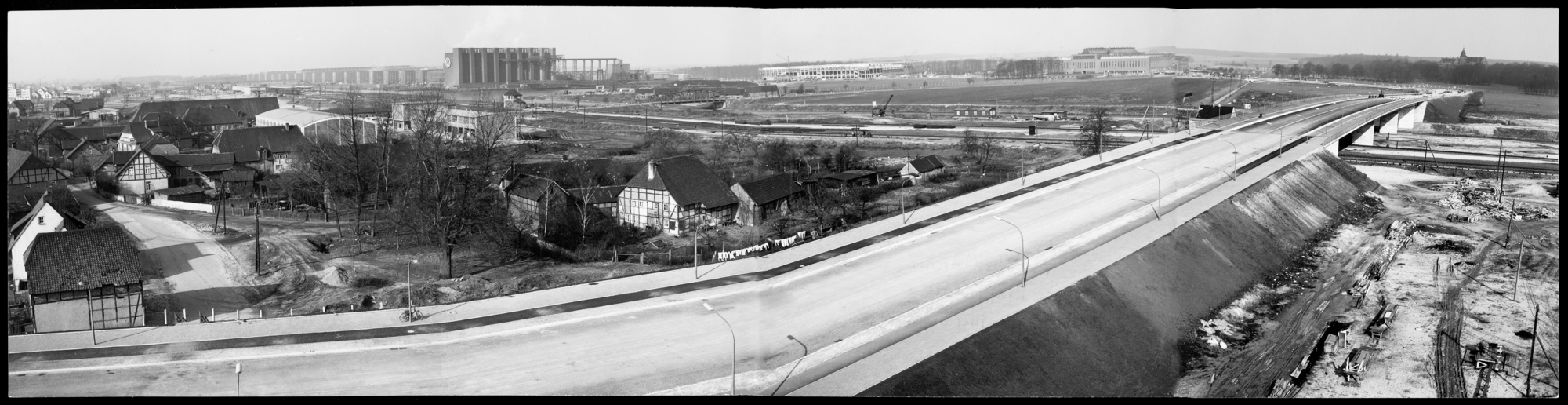
“With over 66,000 vehicles per day, the Berliner Brücke is the most important transportation facility in Wolfsburg,” states the opening line of the brief technical summary prepared in March 2021 by Jürgen Ballmann, then head of the Road Planning and Construction Department, for the decision-making process regarding the development of planning guidelines for the replacement of the Berliner Bridge. The summary continues: “It connects the northern and southern parts of the city, thereby bridging a major urban barrier in the form of the Mittelland Canal and the railroad tracks. A significant component of this crucial transportation link is Structure 01—the ‘Berliner Brücke’—which was built in 1956. The existing structure is a 6-span slab-girder bridge with 5 fields. The central spans are prestressed both longitudinally and transversely. The end spans are made of reinforced concrete and connected to the central section via Gerber joints. The bridge has a total length of 168.70 m and a total width of 29.20 m. Vehicular traffic flows in three lanes in each direction. There is a separate pedestrian and bicycle path on each side.” The construction of the replacement bridge was approved by the Wolfsburg City Council on July 14, 2021.1
This marked the start of concrete planning for the demolition of this historic bridge. The service life of the Berliner Bridge was many times longer than that of its predecessor, the Wolfsburger Bridge. The latter was located about 300 meters further west between Hesslingen and Villa Schlemm, where the Autostadt Corporate Forum stands today. The predecessor bridge was significantly smaller. For 22 years, until the inauguration of the Berliner Bridge, it spanned the Mittelland Canal; the railroad tracks running parallel to it were crossed by a level crossing until it was replaced by the Berliner Bridge.2 The available records did not reveal exactly when the bridge was demolished.
The city and the Deutsche Bundesbahn had recognized that “[d], the railway facilities in Wolfsburg and the associated municipal facilities […] needed to be adapted to meet transportation needs.” After several years of negotiations, a corresponding agreement was concluded in May 1955 and unanimously approved by the city council, in which both parties committed to constructing the necessary new structures. Section 1, Paragraph B states: “The city will endeavor to construct the overpass by October 1, 1956.” For its part, the Federal Railroad agreed to complete the new station building “no later than six months thereafter, if possible […] [zu] .”3 Thanks to thorough preparation and efficient planning, the Committee on Public Works recommended in its special session on November 7, 1955, that the City Council—which was to meet the following day—commission the Holzmann company to construct the bridge.4 Construction was completed in less than a year and a half.
On March 29, 1957, both the *Wolfsburger Nachrichten* and the *Wolfsburger Allgemeine Zeitung* published the invitation from the City Council and the administration to the people of Wolfsburg to attend the bridge’s dedication ceremony. In addition to the list of expected guests of honor, the invitation also included guidelines on proper conduct to ensure that the proceedings and the work of the press, radio, and television could proceed without disruption.5
March 30, 1957, began with a ceremony in the auditorium of what is now the Ratsgymnasium. There, Mayor Arthur Bransch welcomed, in addition to representatives from the City Council and the city administration, the top officials of the surrounding municipalities and districts, as well as those from the neighboring cities of Braunschweig, Fallersleben, and Vorsfelde, as well as representatives from the Volkswagen plant, the Federal Railroad, the Waterways and Shipping Authority, the East German regional associations, and the Berlin Club from Wolfsburg. Guests of honor included Federal Minister of Transportation Hans-Christoph Seebohm, Lüneburg District President Dr. Erich Krause, the representative of the Lower Saxony Minister of Economic Affairs and Transportation, Senior Director of Public Works Wilhelm Lillie; the representative of the Governing Mayor of Berlin and Senator for Transportation and Public Enterprises, Otto Theuner; the Vice President of the House of Representatives, Egon Endres; and the Mayor of Berlin-Kreuzberg, Willy Kressmann. The sheer number of high-ranking guests alone underscores the importance of the new bridge as a central transportation corridor for the region and, beyond that, for connecting east-west traffic and the solidarity with West Berlin that this entails.
Bransch expressed special thanks to the representatives of the participating planning and construction firms, as well as the municipal civil engineering office, who were also present. He then provided insights into the reasoning behind the choice of name, noting that “[v]therlandic perspectives and genuine personal ties” had played a role.⁶ City Manager Wolfgang Hesse and City Planning Director Peter Koller spoke about the bridge’s significance for transportation policy and provided the technical specifications of the new bridge. Hesse concluded with a solemn appeal: “We have built a bridge that leads the way to Berlin. Technology has done its part. May the politicians now find the way to build a great bridge to Berlin and to the Eastern Zone!”7
In the presence of many Wolfsburg citizens, the celebrations reached their climax when Federal Minister of Transportation Seebohm cut the green-and-white ribbon to open the Berlin Bridge, declaring, “THIS STRUCTURE proclaims the creativity and achievements of the city of Volkswagen. May it soon connect all of Germany’s roads!” The guests from Berlin expressed their gratitude to those responsible and emphasized how much they had recognized “the naming of the bridge ‘Berlin’ as a matter close to the hearts of the people of Wolfsburg.” The celebrations concluded with a reception hosted by the city at Wolfsburg Castle, where representatives from the city council and administration raised a toast to the city’s continued development with the guests of honor and representatives from the business community and cultural associations, and discussed future exchange projects between Berlin and Wolfsburg.9
The decision to name the street had in fact been made only shortly before the ceremonial dedication, specifically at the City Council meeting on March 26, 1957. At that time, a unanimous formal resolution was passed to “to name the road leading north—including the section beyond the roundabout between the Heßlingen neighborhood and Dieselstraße—all the way to the junction south of the castle ‘Berliner Ring,’ and to name the new canal bridge along this route ‘Berliner Brücke.’”10
Just how much the young city of Wolfsburg valued its connection to West Berlin became evident nearly three years later, when the erection of a Berlin milestone on April 3, 1960, was intended to serve as another visible symbol of this bond. At the time, it was erected on the median strip of Porschestraße—which was still open to traffic—near City Hall. Today it stands not far from there on Siemensstraße. The Berlin milestone is adorned on both sides by the little bear designed by Berlin artist Renée Sintenis, accompanied by the inscription “Berlin 228 km.”
Beyond its significance in German history, the “Berliner Brücke” is also an important part of many local Italians’ life stories. For many years, the name “Berliner Brücke”—or “Viale Berliner Brücke”—served as the mailing address for those Italians who, beginning in early 1962, lived in the housing development created specifically for them by the Volkswagen plant. When Italian families wrote to their sons, brothers, fathers, and husbands in Wolfsburg, they almost always addressed their cards and letters as “Berliner Brücke” until 1974.
Internally, within the administration, “Berliner Brücke” was also used to identify a specific location within the city limits—for example, as the name of the local district when collecting data on the resident population.11
The end of this bridge’s existence is now becoming increasingly apparent, nearly 70 years after its inauguration. The expanded planning resolution for the replacement of the Berliner Brücke was already adopted by the City Council on September 4, 2024. According to the resolution, the “new bridge is to be constructed in two sections, each with an integrated pedestrian and bicycle path on both sides.”12 Work continues behind the scenes, invisible to the residents of Wolfsburg. Only the current lane restrictions—in effect since November 2022 until the bridge’s demolition—provide everyone crossing the bridge with an unmistakable indication of its age.13 Construction of the new bridge is scheduled to begin in 2029.14
Unexpectedly and prematurely, however—even before demolition and construction work began—the history of the “Berliner Brücke” came to an end on June 30, 2026, as it was renamed the “Carl-Hahn-Brücke” on July 1, 2026. Carl Horst Hahn, the former CEO of Volkswagen AG, would have turned 100 on that day.
-
Footnotes
1 City of Wolfsburg, Proposal V 2021/1739, Development of Planning Guidelines for the Replacement Construction of the Berliner Bridge, available online at https://ratsinfob.stadt.wolfsburg.de/vo020?VOLFDNR=1005705&refresh=false [5.8.2026].
2 “March 30, 1957: A Historic Day,” in: Wolfsburger Nachrichten, March 30, 1957.
3 StadtA WOB, B1.3, No. 71, Agreement between the City of Wolfsburg and Deutsche Bahn dated May 13/18, 1955; StadtA WOB, B.1.1, Nos. 5–13, (regular public) City Council meeting on Friday, May 20, 1955; StadtA WOB, B.1.1, No. 1420, Proposal No. 75, agreement with the Federal Railroad regarding the construction of the new train station, May 13, 1955.
4 StadtA WOB, B.1.1, No. 240, Minutes No. 49/55 (special meeting) of the Committee on Public Works dated November 7, 1955.
5 “Brückenschlag,” in: *Wolfsburger Allgemeine Zeitung*, March 29, 1957; “Invitation to All for the Bridge Inauguration,” in: *Wolfsburger Nachrichten*, March 29, 1957.
6 “Berlin Bridge Open to Traffic,” in: Wolfsburger Nachrichten, August 1, 1957.
7 “Wolfsburg to Prosper—Berlin to Be Honored!” In: *Wolfsburger Allgemeine Zeitung*, April 1, 1957.
8 “May It Connect All Paths,” in: Wolfsburger Nachrichten, August 2, 1957.
9 “Berlin Bridge Open to Traffic,” in: Wolfsburger Nachrichten, August 1, 1957.
10 StadtA WOB, B.1.1, No. 6, Minutes of the 8th (public) City Council meeting on Tuesday, March 26, 1957.
11 StadtA WOB, B.1.2, No. 3903, Structural Studies of the Urban Area—Urban Development; Berliner Bridge.
12 City of Wolfsburg, Proposal V 2024/0848, Replacement Construction of the Berliner Bridge, Expanded Planning Resolution, available online at https://ratsinfob.stadt.wolfsburg.de/vo020?VOLFDNR=1008797&refresh=false [5.8.2026].
13 Information from the City of Wolfsburg, available online at https://www.wolfsburg.de/berlinerbruecke [10.8.2026].
14 Here and in the following, “Wolfsburg’s Important Bridge Has a New Name,” in: Wolfsburger Nachrichten, July 2, 2026.


